Emergency garage door repair
For a door hanging in the opening, stuck open, or with a car behind it.
Emergency repairWhen it happens · Riverside County
A door out of its track is only partly held up. The next few minutes decide whether this stays a repair or becomes an injury, so start with the steps below, then work out which situation you have.
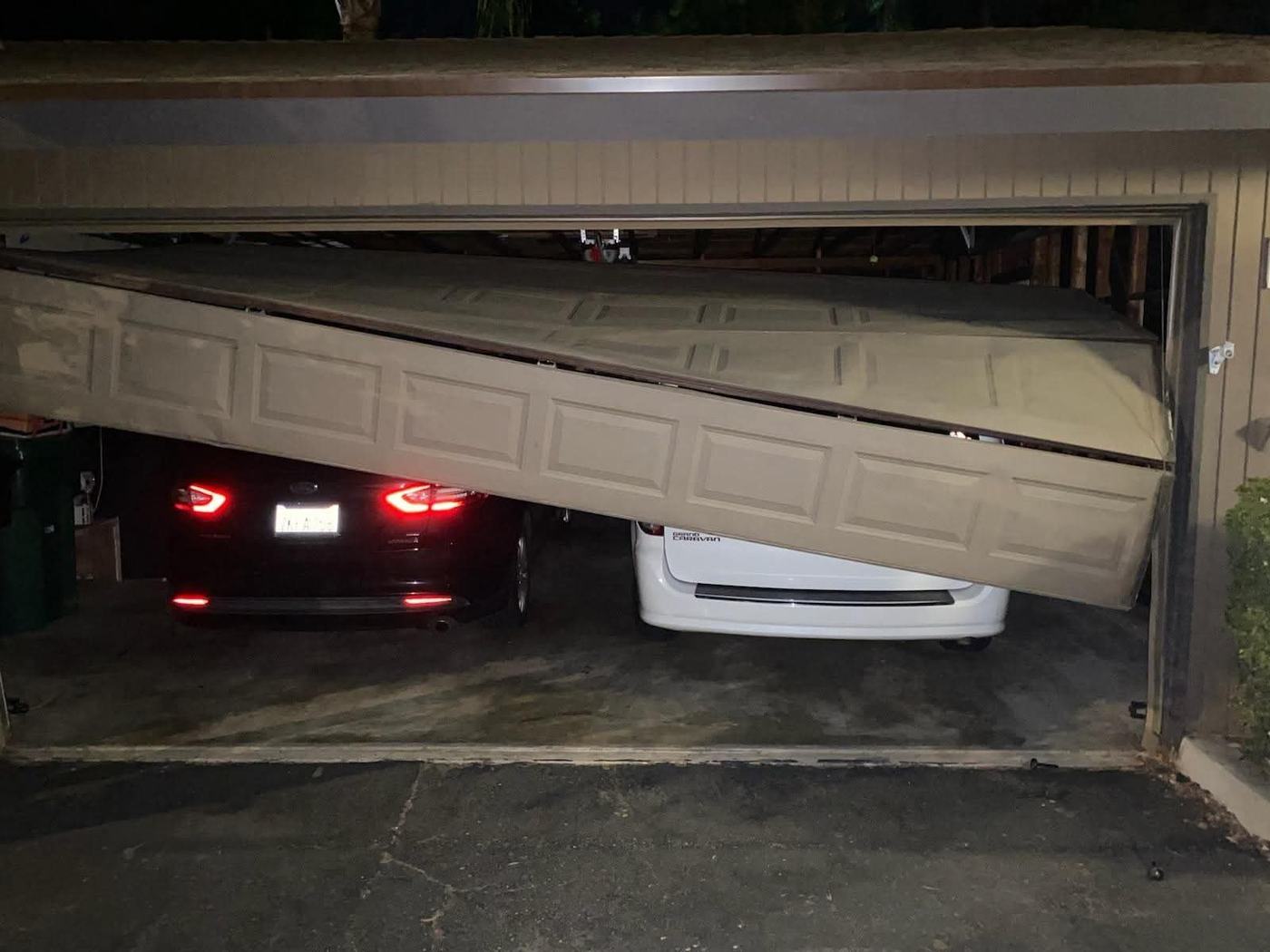
If your garage door has come off its track, stop using the opener, cut its power if you can do that without standing under the door, and keep everyone clear of the door and its path. Don’t push the rollers back in, don’t try to close it by hand, and don’t pull the emergency release while it’s open, because the opener may be part of what’s holding it. Then look from a distance. One roller out on a closed, level door can wait for a booked visit. A door hanging crooked, one side lower than the other, or a door hanging out of the opening is a call to make now. Almost every off-track door has a cause behind it, such as a slipped cable, a bent track or worn rollers, and fixing that is the real repair.
Call (951) 232-9778 Monday–Saturday, 8am–6pm · Closed Sunday
What this guide covers
Standing in the garage now? Do the first section, then use the table to see how urgent it is.
Before anything else
None of these needs tools, and none of them puts you under the door.
Your phone, for photos · The breaker panel, if you know which switch feeds the garage
Time A few minutes
Start here
Pick what the door looks like right now. Three quick questions, no contact details, and you’ll know what to tell us.
Tell Beau what you’re seeing and hearing. There’s no charge for a question.
(951) 232-9778Mon–Sat · 8am–6pmHow serious it is
Off track covers everything from one roller that slipped out to a door hanging out of the opening. Find the row that looks most like your door.
| What you see | What it usually means | How urgent | What to do |
|---|---|---|---|
| One or two rollers out at one spot. The door is closed and sits level. | A bent piece of track at that spot, a broken roller, or a track bracket that worked loose. | Can wait for a booked visit, if it stays closed and still. | Don’t run the opener. Keep the door closed and book a visit. |
| One side is lower than the other. The door sits crooked in the opening. | A lift cable has slipped off its drum or snapped, so one side lost its support. | Call now. The door is unbalanced. | Keep everyone clear. Don’t try to level it by hand. |
| The door hangs out of the opening, tilted, or with sections folded. | Several rollers came out together, usually after an impact or after the opener kept pulling. | Call now. Treat it as able to fall. | Clear the area, cut the opener’s power if it’s safe, and call. |
| A car hit the door, open or closed. | Bent track and at least one bent section. Sometimes a damaged cable too. | Call now if it’s open or hanging. Otherwise book. | Photograph the door and the car before anything moves. The insurance guide covers which policy pays. |
| The door is open and has dropped out of the ceiling tracks. | The rear supports holding the tracks to the ceiling have come loose, or the tracks have spread apart. | The most dangerous case. The door is overhead. | Nobody walks or drives under it. Call now. |
| A roller keeps popping out at the same spot. | Track out of line or bent at that point, or rollers worn past their life. | Book a visit. It will keep happening until the cause is fixed. | Stop using the door until it’s looked at. If it keeps happening after a proper repair, the door itself may be the problem. |
Whichever row you’re in, the first-few-minutes steps above still apply. A door that has left its track once is not a door to test again “just to see.”
Door crooked, or hanging out of the opening?
Keep everyone clear and leave it where it is. Tell us how it’s sitting and we’ll bring what the job needs.
The cause
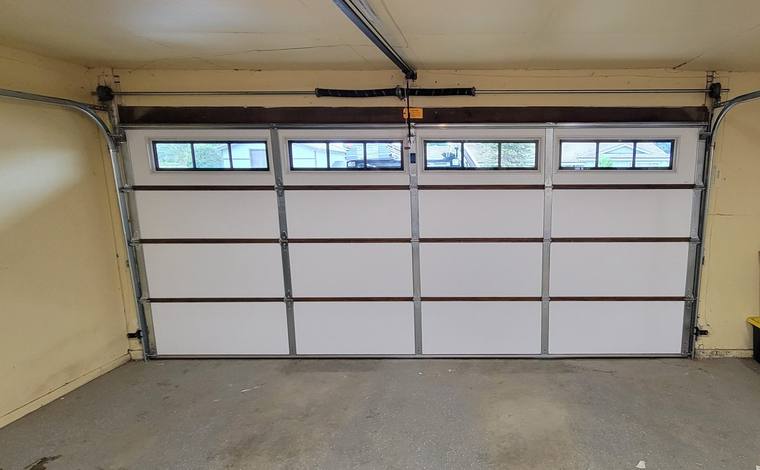
A roller doesn’t leave a straight, well-fastened track on its own. Something pushed it out, pulled it out, or let it drop, and putting the roller back without finding that is how the same door is off track again next month.
The most common cause by a distance is a vehicle. A car reversed into a door that wasn’t fully up, or nudged a closed door, bends the sections inward and pushes the rollers out of the track at the point of impact. Bikes, trailers and a mower backed in at an angle do the same on a smaller scale.
An impact rarely damages only the rollers. The track is usually kinked where the rollers were forced out, and the sections that took the hit may have bent hinges or cracked stiles. That’s why a door that was hit should be looked at even if it seems to run afterward.
The door hangs from two steel cables, one at each bottom corner, wound onto drums at the top. If one cable frays through, snaps, or slips off its drum, that side loses its support. The door tilts, the rollers on the low side bind, and the high side can ride out of its track.
This is the off-track door that most often gets made worse, because it can look like a track problem when it’s really a cable problem. The cable is under tension from the springs, so it’s look-only. Cable repair has its own page, and a door that went crooked right after a loud bang may have a broken spring behind it.
An opener pushes and pulls the door with steady force. If the door can’t move, because a slide lock is engaged, something is in the way, or a spring has failed and the door is too heavy, the opener can drag one side ahead of the other until rollers pop out.
A correctly set opener stops or reverses before that happens. One whose force has been turned up to push past a sticking door won’t. That setting is technician work, and the reversing guide explains why raising it is never the fix. A door that simply won’t lift is a different problem, covered in our guide to a door that won’t open.
Each vertical track is held to the wall by brackets, and the ceiling tracks are held up at the back by supports hung from the framing. When those fasteners loosen, the tracks drift apart or out of line, the rollers ride near the edge of the track instead of the center, and one day a roller comes out at the weakest point, usually the curve.
You can sometimes see it coming: a gap that looks wider at the top than at the bottom, a track that visibly moves when the door runs, or a door that has started to wobble or rub on one side.
A roller with a worn wheel, a seized bearing or a bent stem doesn’t roll; it drags, climbs, and eventually jumps out. Older steel rollers without bearings are the usual culprits, and they tend to announce themselves first with grinding and squealing, which the noise guide sorts by sound.
A single cracked roller is often what lets an otherwise sound door come out at one spot. Replacing the set usually costs less than repairing what a failed roller eventually does to the track.
Less often, it’s simply something in the way: a tool left on the bottom of the track, packed dirt or gravel at the floor, or a storage rack or bike hook that the door catches as it goes up. The rollers climb over it and come out. If you can see the cause at floor level with the door closed, it’s fine to remove it, but don’t run the door to test it; the roller that climbed out still has to be put back properly.
The videos make it look easy
Plenty of videos show a roller being coaxed back in with a pair of pliers. That’s the one case where things go well, filmed after the fact.
Look and photograph everything from a distance: both tracks, both bottom corners, the cables and the spring above the door.
Clear the path of the door and keep people out of it.
Remove something loose you can see in the bottom of a track, with the door closed and without reaching under it.
Lock out the opener at the breaker or the plug, and take the remotes out of the cars.
Guiding rollers back in, prying a track open, or loosening track bolts to line things up.
Anything on the cables, drums, springs or bottom brackets. They’re under tension even when the door is still.
Straightening a bent track or a bent section.
Lifting, lowering or leveling a door that is crooked or hanging.
Putting a roller back works on a door that is closed, balanced, with sound cables and a straight track. On that door, the roller was the only problem. On most off-track doors it isn’t: a cable has slipped, the track is bent, or the door is out of balance, and the rollers that are still in the track are what’s holding it.
Opening the track or lifting a section to line up a roller puts your hands, and often your head, under a door that has already shown it can move on its own. And if the real cause was a cable or a spring, the door comes back out the next time it runs, often further.
On the visit
The order matters more than any single step. A door is made safe before anyone touches a roller.
Secure the door first. Before anything is loosened, the door is clamped or blocked so it can’t move while the rest of the job is done.
Check the springs and cables before the rollers. If a cable has come off its drum or a spring has failed, that is dealt with first, with the load taken off in a controlled way. Reseating rollers on an unbalanced door only puts it back in the same position.
Get the rollers back in, or replace them. Rollers are eased back into straight track, and any that are cracked, worn or bent are replaced rather than reused.
Straighten or replace the track. A kink where the rollers were forced out gets straightened if the metal allows it, or that length of track is replaced. The vertical tracks are set true and the right distance apart, and the ceiling tracks are rehung level on their rear supports.
Tighten or replace what let go. Brackets, hinges and fasteners that loosened or bent are tightened or replaced. A section that took an impact is assessed, and replaced only if it can’t be made sound.
Balance and test. The door is balanced and run by hand before the opener is reconnected. Then the opener’s limits and force are checked, and both safety tests are done: the photo-eye test and the contact-reversal test with a 2x4 laid flat under the door.
Most off-track repairs are finished on the visit when the track can be straightened and the sections are sound. A badly bent section, or a door that has been off track more than once, sometimes means ordering parts, and occasionally means a conversation about the whole door. Either way, you see the damage and the price is agreed before work starts.
If this is what happened
Bent track and at least one bent section, almost always. Leave it where it is. Photograph it and the car, then call.
A spring or a cable let go, and the door lost its balance. Keep everyone clear and call. Don’t lift it or run it.
Usually a bent spot in the track or a broken roller. Leave it closed, don’t run the opener, and book a visit.
Check whether a slide lock or lock bar was engaged. That’s the most common reason an opener ends up fighting a door.
The opener pulled one side out while the door was held. Unlock nothing yet. Cut the opener’s power and call.
The track is out of line there, or the rollers are worn out. Stop using it until the cause is found and fixed.
Rollers forced out on the windward side, and possibly a bent track. Keep clear of it, and don’t try to close it in the wind.
Riverside County specifics
Three local conditions do most of the slow work that ends with a roller out of its track.
Across the inland valleys and the Coachella Valley, the track and its brackets heat and cool through a wide range every day. Over seasons that movement backs fasteners out, the tracks drift out of line, and the rollers ride closer to the edge. A track that rattles or visibly shifts when the door runs is worth having tightened before it lets a roller go.
In Banning, Beaumont, Cabazon and the rest of the Pass, the sustained-wind season runs from late spring into early fall. Wind pushing on a door face forces the rollers against the track, and a door caught half open in a gust is the one that comes out. On a windy day, keep the door fully open or fully closed rather than stopping partway.
In the Coachella Valley and around Blythe, fine sand settles in the bottom of the tracks and in the roller bearings. Rollers that grind instead of rolling climb the track edge, and packed grit at the floor can lift a roller out on the way down. Brushing the track clear, with the door closed and the opener off, is a job you can do yourself.
In Riverside’s older neighborhoods there’s a fourth: original steel rollers without bearings, on doors that have run for decades. They wear flat and crack, and a single failed roller is often all it takes.
Questions
Six ways people ask about it, answered by what the door is doing.
Call and ask. There’s no charge for a question, and Beau has been doing this since 1996.
(951) 232-9778Mon–Sat 8am–6pmOnly in the narrowest case: a closed, level door with one roller out, sound cables and a straight track. Even then it means working with your hands at the track.
On most off-track doors the roller isn’t the real problem. A slipped cable, a bent track or an unbalanced door is, and the rollers still in the track are what’s holding it. Look, photograph, keep clear, and have it repaired.
A closed door with one roller out that is sitting level and still can usually wait for a booked visit, as long as the opener is off and nobody runs it.
A door that is crooked, hanging, or open and out of its ceiling tracks is not safe to leave. Keep people and cars away from it and call.
Most often something hit it, usually a car. The other common causes are a lift cable that slipped off its drum or snapped, an opener pulling against a locked or stuck door, track that worked loose or out of line, and worn or broken rollers.
Finding the cause is the real repair. Putting a roller back without it is how the door comes off again.
Don’t try, either by hand or with the opener. Pulling it down drags it further out of the track and can fold a section.
If it’s stuck open, the house isn’t secure, which makes it an urgent call rather than a reason to force it. Keep everyone clear until it’s been made safe.
It depends on why it happened. Sudden damage, such as a vehicle impact, is the kind of loss policies are written for, and where a car caused it, the auto policy may be involved.
Wear, like worn rollers or loose track, generally isn’t covered. Photograph everything before it’s moved, then read our insurance guide before you file.
Usually not. Most off-track doors need rollers, a length of track, a cable or a hinge, and they run normally afterward.
A section that was badly bent in an impact may need replacing, and a door that keeps coming off after a proper repair is worth a conversation about the whole door. You see the damage before anything is agreed.
Further reading
For a door hanging in the opening, stuck open, or with a car behind it.
Emergency repairThe cable that lets go on one side is behind many crooked, off-track doors.
The cable pageWorn rollers climb the track long before they come out. How a set is chosen.
The roller pageOn the visit
We make the door safe before we touch it, then find out why it left the track. That usually means looking at the cables and springs before the rollers, because the rollers are rarely the whole story.
You see what failed before any work starts, and the price is agreed before we pick up a tool. When we leave, the door has been balanced by hand, run on the opener, and put through both safety tests, including the contact-reversal test with a 2x4 laid flat.
We work across all of Riverside County from our shop on Industrial Avenue in Riverside, and looking at a door costs nothing.
Tell us how the door is sitting and what happened just before. It tells us what to bring. Looking is free, and the price is agreed before any work starts.
Riverside Classic Garage Doors · 6410 Industrial Ave #3, Riverside, CA 92504 · (951) 232-9778 · Monday–Saturday, 8am–6pm · Closed Sunday