Garage door replacement
If it is the door: how a replacement goes, what is included, and the four material tiers.
The replacement pageRiverside County, California · Repair or replace
Most articles answering this list six vague signs and leave you no better off. The useful version starts somewhere else: a garage door is four separate things, and only one of them is the door.
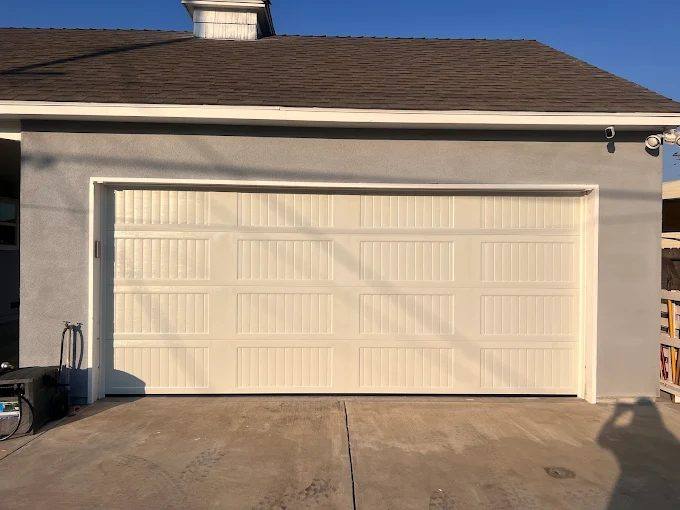
Replace the door when the sections or the opening have failed structurally. Replace a part when a part has failed — which is most of the time. A garage door is four assemblies on four separate clocks: the sections, the counterbalance (springs, cables and drums), the operator, and the track and hardware. A broken spring, a dead opener, worn rollers or a single dented section are all part-level failures on a door that may have years left in it. What genuinely ends a door is structural: sections delaminating, rusting through or cracked at the stiles; a door that has come off its track repeatedly; a profile no longer manufactured, so damage cannot be matched; or an opening that is out of square in a way that cannot be corrected. The practical test is not how old it is. It is whether the thing that failed can be replaced independently — and how many separate failures the door has produced in the last twelve months. We will tell you honestly when a door has life left in it, and looking at it is free.
Call (951) 232-9778 Monday–Saturday, 8am–6pm · Closed Sunday
What this guide covers
The short version is the table: find the part that failed and see whether it ends the door or not. The rest is the five things that genuinely do end one, and the four that look like they should and do not.
The mistake every other article makes
Treat it as one object with one lifespan and every decision that follows is wrong.
What is bolted to the front of your garage is four assemblies that happen to be attached to each other, and they wear out at completely different rates and for completely different reasons.
The sections are the door itself — the panels you see from the street, their stiles and rails, their skin and whatever is inside them. This is the long-lived part, and it is also the only part whose failure genuinely means a new door.
The counterbalance is the springs, the cables, the drums and the shaft above the opening. It carries the entire weight of the door and it is rated in cycles rather than years. It is a consumable, designed to be replaced, and its failure says nothing about the door.
The operator is the opener: a motor, a gearbox, a logic board and a rail. It is an appliance bolted to the ceiling, it has an appliance's service life, and it can be swapped without touching anything else.
The track and hardware are the rollers, hinges, brackets, track and the fasteners into the jamb. Individually cheap, individually replaceable, and collectively the thing that decides whether the door runs true.
Almost every “do I need a new garage door?” question is really “which of these four has run out?” — and three times out of four the answer is a part rather than the door. The reason people get talked into full replacements they did not need is that this distinction is never drawn for them.
The exception worth knowing: the counterbalance is sized to the weight of the sections. So a change to the door changes the springs, but a change to the springs does not change the door. The cycle arithmetic behind spring life is in the maintenance guide.
Next step
Most failures are part-level. Start with what the door is doing, or skip straight to a measure.
Three quick questions narrow it down before you talk to anyone.
(951) 232-9778Mon–Sat · 8am–6pmStart here
The nine failures we are called out to most, and which of the four assemblies each belongs to.
| What failed | Which assembly | Does it end the door? |
|---|---|---|
| A spring brokeThe bang, and the door will not lift. | Counterbalance | No. A cycle-rated consumable doing what it was always going to do. Says nothing about the sections. |
| A cable snapped or jumped its drum | Counterbalance | No — but find the cause. A cable failure is usually a symptom of something else, and that something else might matter. |
| The opener died | Operator | No. An appliance reached the end of its life. It is swapped without touching the door — though in California a new door brings its own rule about the opener. |
| The door is loud | Track and hardware | No. Almost always worn rollers and loose fasteners, and the cheapest thing on this list to put right. |
| One section is dentedSomebody reversed into it. | Sections | Maybe. It turns on whether the profile is still made and whether the color still matches after years of sun. |
| The door came off its track once | Track and hardware | No, if the cause is found and corrected. A roller that has been off the track rarely runs the same again, so it gets replaced rather than re-seated. |
| The door has come off its track repeatedly | Sections and track together | Often yes. Repeated off-tracking usually means the door is no longer running true, and that is a geometry problem rather than a parts problem. |
| Sections delaminating, rusted through, or cracked at the stiles | Sections | Yes. This is the failure that genuinely ends a door. The stiles are where the hardware bolts on; once they are gone there is nothing sound to bolt to. |
| The finish has chalked or the wood has had its last refinish | Sections, cosmetically | Your call, not a technical one. A tired finish on a sound door is an appearance decision. It is a legitimate reason to replace — just not a structural one. |
Six of those nine are part-level. That ratio is roughly what we see on the driveway too, which is why we would rather look at a door than quote a replacement over the phone — and why we do not quote one over the phone at all.
Structural end-of-life
If none of these is true, the honest answer is almost certainly that you have a repairable door and a failed part.
The stiles are the vertical members at the ends of each section, and they are where every hinge, roller bracket and bottom fixture bolts on. Once they are cracked, corroded through or pulling apart, there is nothing sound left to attach hardware to. You can keep re-fixing into damaged material for a while; you cannot do it indefinitely, and a hinge tearing out of a stile at height is not a small failure.
On an insulated door the skins and the core act as one structural sandwich. When that bond fails the section stops being a beam and starts being two thin sheets, and it will bow under its own weight and under wind. You can see it as a ripple or a soft spot in a panel that used to be flat. There is no repair for it.
Surface rust on a steel door is cosmetic and treatable. Corrosion that has perforated the skin, or that has eaten into the stiles and the bottom fixture, is not. In the Palo Verde Valley this is the failure we see most, and it starts at cut edges and fastener penetrations rather than in the middle of a panel.
Once is an incident with a cause. Twice or more usually means the door is no longer running true — sections out of plane, a bowed panel, a track that has been re-formed, or an opening that has moved. That is geometry rather than parts, and past a point it cannot be corrected by replacing components.
This decides most damaged-section questions. If the exact profile is no longer made, a damaged section cannot be matched, and a mismatched section on the front of a house is usually worse than a new door. Age is not the test here — some fifteen-year-old profiles are still current and some eight-year-old ones are gone.
Where the jamb has rotted, the header has sagged, or the opening has gone out of square beyond what packing can correct, the problem is the building rather than the door. A new door will not fix it, and hanging one on it wastes the door. This is worth diagnosing properly before anybody orders anything.
None of these is about age, and that is deliberate. We have replaced doors that were eight years old and serviced doors that were thirty. What matters is which of these is true of yours.
Before you agree to a replacement
Each of these gets used as a reason to sell a new door. Each of them is a part.
That is a spring, and the door being completely immovable is exactly what a broken spring looks like — the springs carry the weight, not the opener, so with one gone the door is simply too heavy to lift.
It is dramatic, it is sudden, and it is a consumable reaching the end of its rating. It says nothing whatsoever about the condition of the sections.
Counterbalance, not the door. Have the spring replaced and the door balance-tested. What that involves.
Noise is the most common reason people start thinking about a new door, and it is almost always the cheapest thing on the door to fix. Worn steel rollers with no bearings, dry hinges and fasteners that have worked loose account for nearly all of it.
A door that has been made quiet with sealed nylon rollers and a proper hardware check sounds like a different machine, and nothing about the sections changed.
Track and hardware. Rollers, hinges and a hardware re-torque. The roller page covers it.
An opener is an appliance with an appliance's life, and in this county it is frequently the first of the four assemblies to go — it hangs at the hottest point of an uninsulated ceiling and is worked hard.
Replacing it does not require touching the door, and a sound door will run on a new operator without complaint.
Operator only. Swap the operator — but check first whether California’s opener rule affects the job.
This is the genuinely uncertain one, and the answer is not about how bad the dent looks. It is about whether the exact profile is still manufactured and whether the color will still match sections that have been in Riverside County sun for a decade.
Where both are true, a section swap is straightforward. Where the profile is gone, a mismatched panel on the front of the house is usually the worse outcome.
It depends, genuinely. We match it before we advise, rather than after. How panel matching works.
When parts stop being the answer
Everything above says most failures are part-level. There is a point where that stops being the useful frame, and it is not reached by any single failure — it is reached by their frequency.
The question worth asking is: how many separate, unrelated failures has this door produced in the last twelve months? Not one thing failing twice, which usually means the first repair did not address the cause. Separate things: a spring, then a roller, then a hinge, then a cable.
One is normal. Two can be coincidence, particularly if the door is a decade or more old and everything was installed on the same day. Three or four unrelated failures in a year is a pattern, and the pattern is telling you the whole assembly has reached the same age at once — because it did. It all went on together.
At that point you are not maintaining a door, you are replacing it one component at a time, in the least efficient order possible, paying a visit charge each time. That is the honest argument for replacement, and notice that it is an argument about frequency rather than about any figure.
The counter-argument is equally honest and we make it just as often: if the door has produced one failure, and the sections are sound, and the profile is current, then replacing the door is buying a solution to a problem you do not have.
We are not the right people to ask about your budget. We are the right people to tell you which of the four assemblies has failed, whether the sections are sound, and whether the profile still exists — and those three facts decide it more reliably than age does.
Not sure which of the four has run out?
We’ll tell you straight whether the door has life left. If it does, that’s what you’ll hear.
Riverside County specifics
The four clocks do not run at the same speed everywhere, and knowing which one your climate attacks tells you what to watch.
This is the part a national article cannot give you, and it changes what “time for a new door” means from one end of this county to the other.
Thermal cycling backs fasteners out and grit finishes the rollers, so the track-and-hardware clock runs fastest here. That is the cheapest of the four to renew, which is why inland doors are frequently worth keeping well past the point owners expect.
The sections themselves do well in this zone. Western Riverside doors are usually a hardware conversation.
Radiant heat kills operators early — the head hangs at the hottest point of an uninsulated ceiling — and ultraviolet takes the finish long before the steel behind it is compromised.
So the desert produces the most misleading version of this question: a door that looks finished and is structurally fine. The decision there is genuinely an appearance one, and what to specify so the next finish lasts matters more than the timing.
This is the one zone where structural end-of-life is common rather than unusual. Sustained wind bows under-strutted panels, works the track and eases fasteners out of the jamb, and repeated off-tracking is the classic pass pattern.
A pass door that has come off its track more than once is the strongest replacement case in the county — and the replacement should be a rated assembly rather than a like-for-like of something that was under-specified originally. Banning and the rest of the corridor.
Desert heat with river humidity attacks steel in a way neither condition does alone, and here the counterbalance and the sections can fail on the same clock — springs pitting, cables going from the inside out, and skins perforating from cut edges.
This is the zone where a door genuinely can be past repair while looking serviceable from the driveway. Blythe is scheduled deliberately and we arrive loaded.
Questions
Six questions this gets asked as, answered on condition rather than on age.
Call and ask. There’s no charge for a question, and Beau has been doing this since 1996.
(951) 232-9778Mon–Sat 8am–6pmWork out which of the four assemblies failed. A spring, a cable, an opener, rollers, hinges or track are all parts, and replacing them says nothing about the door. What genuinely ends a door is structural: sections delaminating, corroded through or cracked at the stiles, an opening that has moved, a profile no longer made, or a door that keeps coming off its track.
If none of those is true, you have a repairable door and a failed part. Age is a poor test — we have replaced doors at eight years and serviced them at thirty.
Sometimes, and appearance is a legitimate reason. On most Riverside County elevations the garage door is the largest single surface visible from the street, and a chalked or dated door ages the whole house.
Just be clear with yourself and with whoever is quoting that it is an appearance decision rather than a structural one. A sound door being replaced for how it looks is a perfectly good reason; a sound door being replaced because somebody implied it was unsafe is not.
Once, with a cause found and corrected, almost certainly not. Something stopped one side while the other kept going — an obstruction, a failed cable, or a roller that had already gone — and the roller involved gets replaced rather than re-seated, because one that has been off the track rarely runs the same again.
Repeatedly is a different answer. Recurrent off-tracking usually means the door is no longer running true, which is geometry rather than parts, and past a point it cannot be corrected by replacing components.
Count separate, unrelated failures in the last twelve months — not one thing failing twice, which usually means the first repair missed the cause. One is normal. Two can be coincidence on an older door.
Three or four unrelated failures in a year is a pattern, and it is telling you the whole assembly reached the same age at once, because it was all installed on the same day. At that point you are replacing the door one part at a time in the least efficient order.
Often, if the weight is similar and the unit is sound. Moving from a light uninsulated door to a heavy insulated or wood one may be more than it can honestly carry.
There is also a legal dimension in California: a replacement door may not be connected to an existing opener that lacks battery backup. That is worth establishing before you choose a door rather than on installation day.
Not structurally. A chalked, faded or repeatedly-refinished surface on sections that are still sound is a cosmetic condition, and steel doors in this county routinely outlast their original finish by a wide margin.
Whether that is worth living with is your call. What we would say is: establish that the sections, the stiles and the opening are sound first, so you are making an appearance decision with the facts rather than being sold a structural story.
Further reading
If it is the door: how a replacement goes, what is included, and the four material tiers.
The replacement pageIf it is not: the check that catches part-level failures before they strand you, zone by zone.
The maintenance guideIf you are replacing: what to specify so the next one survives what finished this one.
The specification guideThe practical offer
Coming out to look is free, and the answer we give most often on this question is that the door is fine and a part has failed. That is not a sales position, it is just what the ratio actually is — six of the nine most common failures we are called to are part-level.
What you get is the diagnosis rather than a verdict: which of the four assemblies failed, whether the sections and the stiles are sound, whether the opening is still square, and whether the profile is still made. Those four facts decide the question, and none of them can be established from a photograph or a phone call.
And where the honest answer is that the door has reached the end, you get told that plainly too, with the reason. We cover the whole of Riverside County from one shop in Riverside, and the person who answers the phone is the person who comes and looks at it.
Tell us what the door is doing and roughly how old it is. We will tell you which assembly failed, whether the sections are sound, and whether you are looking at a part or a door — before anybody talks about a new one.
Riverside Classic Garage Doors · 6410 Industrial Ave #3, Riverside, CA 92504 · (951) 232-9778 · Monday–Saturday, 8am–6pm · Closed Sunday