Garage door replacement
How a replacement actually goes, what is included, and the four material tiers in full.
The replacement pageRiverside County, California · Specification guide
The same door specified for Eastvale and for Blythe does not fail the same way, and it does not fail at the same time. Most buying guides treat California as one climate. This county is six.
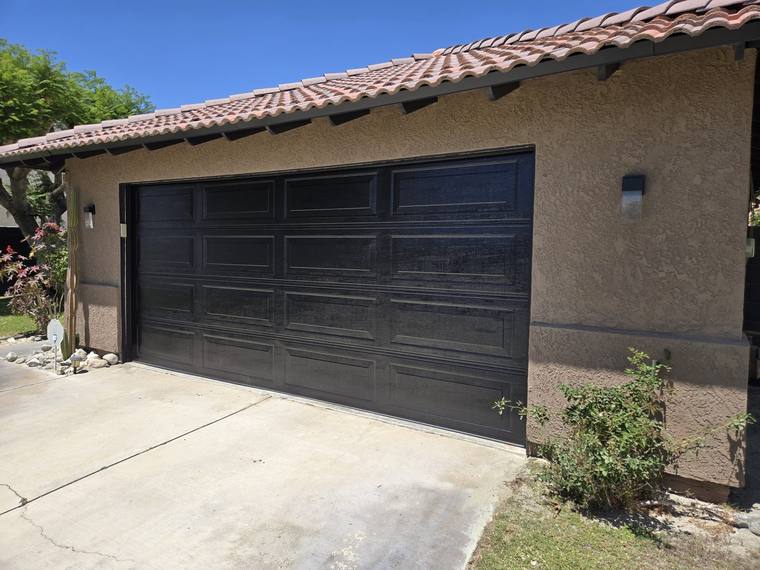
Riverside County is six climates, not one, and the door that lasts in Indio is not the door for Idyllwild. Ultraviolet and surface heat decide the finish. Blown grit decides the seal and the hardware. Sustained wind through the San Gorgonio Pass decides the steel gauge and the strut count. Cold and damp at four to five thousand feet decide whether there is a thermal break at the floor. An insulated door will not cool an unconditioned garage — it slows the heat crossing it. So the useful question is not which door is best, it is what to specify where you live: skin and construction, insulation, finish and color, hardware and struts, seal, and the operator. Specify for your zone and the door outlasts the one next door. We do not quote garage door work over the phone and we do not charge to come and measure it.
Call (951) 232-9778 Monday–Saturday, 8am–6pm · Closed Sunday
What this guide covers
The middle of this guide is one section per climate zone. Find yours in the table, read that section, and you can skip the other five — they are written for someone else’s weather.
Start with what is actually possible
“Why is my insulated garage still so hot?”
Because an unconditioned garage has nothing in it that makes cold. Insulation is not a cooling device and it does not move heat out of a space; it slows heat crossing a surface. On a garage with no cooling source, that means the room settles nearer the day’s average than the afternoon peak, and the swing between morning and evening gets narrower. It does not mean the garage gets cool, and any supplier who implies otherwise is selling you something.
What an insulated door does deliver is worth having, and it is more specific than “energy efficiency”. The inside skin runs closer to air temperature, so you are not standing next to a radiant panel. The door is stiffer, because the insulation is doing structural work as well as thermal. And it is quieter, which matters more than people expect when there is a bedroom over the garage.
The other half of the answer is that the door is one surface out of six. A garage has four walls, a ceiling and a slab, and on most Riverside County tract houses the ceiling is uninsulated and the roof above it is in full sun from noon. An insulated door under that ceiling will disappoint, and the disappointment will be blamed on the door. If the garage is attached, the surface that actually protects the house is the wall and ceiling between the garage and the living space — that is the thermal boundary, not the door.
That is the honest framing for the whole of this guide. The door is worth specifying properly for what it can do: survive the exposure it lives in, keep grit out, hold its shape under wind, and carry its own weight for a decade or more without becoming dangerous. If you want the short version of what R-value means, we answer that plainly on the answers page. If you want to know which door to buy, keep reading — but the number on the brochure is not the one to compare.
Next step
The specification in this guide only works on a door that fits the opening. Pick where you are and we’ll take it from there.
Three quick questions narrow it down before you talk to anyone.
(951) 232-9778Mon–Sat · 8am–6pmThe number on the brochure
This is the single most useful thing on this page, and almost nobody selling doors will volunteer it.
It is a calculation, not a measurement, and it is a calculation through the center of one section. It sums the insulation and a pair of assumed air films, treats the steel facings as negligible, and takes the insulation’s conductivity from a laboratory test at a single average material temperature. It says nothing about the rails, the stiles, the joints between sections, the perimeter, or the door as installed in your opening.
This is not a critic’s objection, it is the industry position. DASMA — the door manufacturers’ own association — states in its technical data that the section calculation and the whole-door measurement “are obtained by entirely different methods reflecting different aspects of thermal performance”, that “U-factor and R-value are not reciprocals of each other”, and elsewhere that R-value is of limited usefulness for a door assembly.
So two doors can both be labeled with a high R-value and perform differently in your opening, and a door with a lower number and better construction can be the better door. The figure is not a lie. It is just not a comparison.
Ask for the U-factor, and ask whether it was tested on a complete door assembly. That test exists: ANSI/DASMA 105, built on the ASTM hot-box method, measures the whole installed door rather than a slice through the middle of a panel. It is reported in Btu per hour per square foot per degree Fahrenheit, and unlike R-value, lower is better — a door at 0.20 is roughly twice as good as one at 0.40.
Then ask the question that separates a real figure from a marketing one: is that U-factor on DASMA’s thermal performance verification list, which is administered by ICC-ES? Participating manufacturers publish verified numbers. A supplier who cannot answer either question is quoting you a brochure.
The building codes work in U-factor too, which is the tell. When a regulator needs a number it can rely on, it does not use the one on the sticker.
R-values on garage doors are really describing construction, so specify the construction and you have said the same thing more precisely. Single-layer steel is a skin with nothing behind it and effectively no insulation. Two-layer is a skin with a polystyrene board cut to fit and dropped into the pan — better, and the board is a separate part that can rattle. Three-layer is polyurethane foamed in place between two skins, where the foam bonds to both and becomes structural; that is why a three-layer door is noticeably stiffer and quieter as well as warmer.
Every zone verdict below is written in those terms rather than in R-value floors. It is more honest, it is harder for a supplier to fudge, and it is the language a specification is actually written in. Where you want the material detail behind each option, the steel door page carries it.
The whole guide on one screen
Find your zone, take the row, and ask every supplier to quote against it. A specification is what turns three incomparable quotes into three comparable ones.
| Zone | Skin and construction | Insulation | Finish and color | Hardware, gauge and struts | Seal and operator |
|---|---|---|---|---|---|
| The inland valleysRiverside, Corona, Moreno Valley, Jurupa Valley, Eastvale, Norco, Perris, Temecula, Murrieta, Menifee, Lake Elsinore · Western Riverside | Insulated steel, two or three layerThree-layer bonded construction if the garage adjoins living space or gets used daily. | Ask for the verified U-factorWorth paying for on an attached garage; on a detached store it buys stiffness and quiet, not a bill saving. | Factory finish, mid or light toneWest-facing openings run a season ahead of the rest of the street on every kind of wear. | Standard rating, re-torquable hardwareDaily thermal movement backs fasteners out. Specify hardware you can tighten, not crimped parts you replace. | Standard seal; any current operatorConfirm the operator meets the battery-backup rule before it is reconnected. |
| The Hemet and San Jacinto valleyHemet, East Hemet, San Jacinto, Valle Vista, Green Acres, Homeland, Nuevo, Winchester · Pass & Hemet Valley | Insulated steel, and measure firstA lot of this stock is not a modern stock size. The opening decides the door here, not the catalog. | Two-layer is usually the right callOlder detached garages rarely justify the top tier; put the money into hardware and counterbalance. | Factory finishHot afternoons and cold damp mornings in the same week are hard on a field-applied coat. | New track, and convert to torsionCarrying over 1960s and 70s hardware to a new door is where these jobs go wrong. | Full perimeter seal; new operator likelyPre-rolling-code operators are a security fault as much as an age one. |
| The San Gorgonio PassBanning, Beaumont, Calimesa, Cherry Valley, Cabazon, Whitewater · Banning | Wind-load rated, by decimal thicknessAsk for the thickness in thousandths of an inch, not a gauge number. See the pass section below. | Three-layer for stiffness firstHere the bonded section is bought for what it does structurally, not thermally. | Factory finishWind carries sand, and sand abrades a field coat far faster than a baked one. | The manufacturer’s full strut packagePlus the specified jamb and track fixing. The rating belongs to the assembly, not the panel. | Heavier astragal and side sealA seal that closes on a still day can lift under pressure. Specify it; do not add tape later. |
| The Coachella ValleyPalm Springs, Palm Desert, Cathedral City, Rancho Mirage, Indian Wells, La Quinta, Indio, Coachella, Desert Hot Springs, Bermuda Dunes, Thousand Palms · Coachella Valley | Insulated steel, or anodized aluminumFull-view aluminum is viable here, but the glazing choice is a real decision. | Three-layer, and insulate the ceiling tooThe door protects the mechanism hanging off it as much as the space. | Factory finish, light colorDark colors on a full-sun opening can bow a section, and some warranties exclude them. Ask for both documents. | Sealed bearings throughoutOpen stems and blown sand are the shortest route to a dragging door. | Specified seal; operator with a stated ambient rangeThe head hangs at the hottest point of the ceiling. Ask what it is rated to. |
| Idyllwild, Anza and AguangaThe mountain communities, four to five thousand feet · Idyllwild | Insulated steel, or real woodThe only zone where wood is a straightforwardly good idea, and refinishing is the trade-off. | Three-layer with a genuine thermal breakAttached, under living space, this is the one zone where the national winter advice is right. | Any tone; finish every faceOn wood, every face of every section, including the top and bottom edges. | Counterbalance to the finished doorSprings sized to the glazed, finished weight — not to a catalog figure for a bare door. | Thermal-break astragal; battery backup essentialNot a legal box here so much as a practical one: power goes out and the road is a road. |
| Blythe and the Palo Verde ValleyBlythe, Ripley, Mesa Verde, Lost Lake · Palo Verde Valley | Galvanized substrate, factory two-coatThe one corner of the county where you specify against corrosion as well as heat. | Two or three layerSecondary here. Corrosion resistance is the decision that matters. | Factory finish; watch the cut edgesCorrosion starts at cut edges and fastener penetrations, not in the middle of a panel. | Corrosion-resistant hardware, springs kept dryRust reduces the effective area of spring wire and seeds the pit a fatigue crack starts from. | Full seal; operator rated for heatDesert temperatures with river humidity is the worst combination in the county. |
Nothing in this table is a price and none of it needs to be. It is a specification, and a specification is what stops three quotes being compared on the only number they have in common. How our own pricing works is a separate page, and it has no figures on it either.
Zone one
Riverside, Corona, Moreno Valley, Jurupa Valley, Eastvale, Norco, Perris, Temecula, Murrieta, Menifee and Lake Elsinore.
Nothing here is extreme, and that is what makes this zone easy to under-specify. There is no wind corridor, no salt, no freeze and no sand blast. What there is instead is a thirty-degree swing between a spring morning and a spring afternoon, three hundred-odd times a year, and dust in everything. The mechanism this drives is already documented across our Western Riverside pages: fasteners work loose a fraction on every cycle until a door that was hung true is running out of square.
The specification answer is not a heavier door. It is a stiffer section and hardware you can maintain. A bonded three-layer section resists the racking that loosens things in the first place, and hardware that can be re-torqued — proper bolted brackets and hinges rather than crimped assemblies — means the annual half-hour actually fixes something. Ask specifically whether the hinges and brackets are serviceable parts.
On insulation, this is the zone where the real decision is what the garage is for, and almost nobody frames it that way. Attached and under or beside living space: insulate properly, and understand that you are buying a warmer wall for the house and a quieter door, not a cool garage. Attached but unconditioned and used every day: three-layer still earns it on stiffness and noise. Detached workshop or gym: worth it for the swing and the quiet. Detached and used for storage: put the money into the door and the hardware instead, because there is nothing behind the door to protect.
Finish is straightforward — a factory-baked coat in a mid or light tone. The only local caveat is orientation. A west-facing opening in this zone takes materially more ultraviolet and heat than a north-facing one on the same street, and it will show wear first on the seal, the finish and the opener. If your opening faces west, specify as though you were a zone further east.
The operator here can be any current unit, and the drive type is a comfort question rather than a climate one — the opener page covers that choice. The climate-relevant point is the one buyers get caught by: if your existing opener predates July 2019 and has no battery backup, it may not legally be reconnected to a replacement door. That is covered further down. For the material itself, insulated steel is the right default for most of this zone and there is no shame in it.
Zone two
Hemet, East Hemet, San Jacinto, Valle Vista, Green Acres, Homeland, Nuevo and Winchester.
The heat arrives earlier and harder here than inland, and the winter mornings are genuinely cold and damp, so on paper this zone looks like a slightly worse version of zone one. In practice it is a different job, because the housing is older and the constraint is not the weather. It is the opening.
A large share of this stock is 1950s through 1970s, and on a garage of that age three things are routinely true. The opening is not a modern stock size, so a door has to be made to it or the opening has to be altered. The headroom is tight, sometimes tighter than a standard torsion assembly wants. And the jamb is wood that has had forty years of a door bolted to it. None of that can be assessed from a photograph, which is the honest reason we will not specify a door here over the phone.
The second thing that decides the job is the counterbalance. A lot of valley doors still run their original extension springs along the horizontal tracks. If yours does, look for a containment cable threaded down the middle of each spring: without one, a failed extension spring is a projectile. Where we are replacing a door in this zone we would nearly always convert to a torsion bar above the opening if the headroom allows, and specify it against the measured weight of the new door. Our spring page explains what that sizing involves.
There is a reason to be firmer about balance here than anywhere else in the county, and it is not mechanical. A great deal of this housing is occupied by people who cannot lift a heavy door, and an out-of-balance door is completely invisible while the opener is working. The moment the power goes out, that door has to be lifted by hand. A correctly balanced door of any size can be lifted by one person, and we balance-test by hand on every visit for exactly that reason.
Insulation is usually the two-layer answer here rather than the top tier — a lot of these garages are detached and used for storage, and the budget does more good in the track and the springs. Finish should be factory-applied. And on the operator, be aware that units of this vintage often predate rolling-code security: if the remote is a two-button unit with switches inside the case, the opener can be cloned from the street. That is a replacement on security grounds, whatever its age. For the door itself, insulated steel made to the measured opening is the usual answer.
Zone three
Banning, Beaumont, Calimesa, Cherry Valley, Cabazon and Whitewater.
If your door rattles in the wind, bangs against its track, bows visibly in the middle when it is halfway up, or has ever been pushed off its rollers, this section is the one that matters and the rest of the guide is detail. The pass funnels air between two ten-thousand-foot peaks. The turbines are there for a reason, and a sixteen-foot door is over a hundred square feet of sail.
Start with the skin, and ask for it in the right units. Steel thickness is quoted as a gauge number, gauge runs backwards to thickness, and — the part nobody mentions — the tolerance is wide enough to matter. DASMA is explicit that the gage number is not the same thing as the actual decimal thickness, and the mill tolerance on 24 gauge is around three thousandths of an inch, which is enough for two doors both sold as 24 gauge to be meaningfully different. So do not ask for a gauge. Ask for the decimal thickness in thousandths, and get it written on the quote.
Then the reinforcement, which is what actually carries the load. Manufacturers make their doors wind resistant with horizontal struts, and DASMA’s technical data on reinforcement notes that horizontal struts are sometimes not enough and a vertical post system is required instead, transmitting the load into the header and the floor. Two consequences follow. First, the strut package is part of the rating, not an upgrade — a door rated on paper and installed without its struts is not a rated door. Second, a post that did not come from or was not specified by the door manufacturer may not resist the wind the way the tested assembly did.
Two more things belong in a pass specification and both are routinely left out. Wind works in both directions: a door is either blown into the garage or sucked out of the opening, so the positive and negative pressure ratings both matter. And the fixing of the track and the jamb into the building is as critical as the strength of the door itself — there is a whole DASMA data sheet on jamb-to-framing connection, because that joint is where wind-damaged doors usually let go.
The one thing not to do is bolt reinforcement onto the door you already have. DASMA warns directly that adding non-specified weight can overload the track and the counterbalance, and that a genuine upgrade is a package: struts, springs, hardware and supporting track together. A homemade brace makes a heavy door heavier and the springs were sized for the old weight. For the material, rated insulated steel is the specification here, and everything in this section should appear on the quote in writing. Communities across the pass and the Hemet valley are covered from our Riverside shop.
There are no wind speeds in this section on purpose. The county does publish design load criteria, and the section below tells you how to find out what applies at your address — but the figures in that handout are not something we are willing to restate second-hand.
Zone four
Palm Springs, Palm Desert, Cathedral City, Rancho Mirage, Indian Wells, La Quinta, Indio, Coachella, Desert Hot Springs, Bermuda Dunes and Thousand Palms.
Out here the steel usually outlives the coating on it, which inverts the normal buying logic. A door that would be fine for thirty years in Riverside can look tired in eight on a south or west elevation in Indio, and it will be the finish, the seals and the opener that went — not the door.
So the first specification decision is factory finish over field paint, and it is not a close call. A prepainted coil coating is a very thin organic film applied and cured under controlled conditions on flat stock before the panel is formed. A coat applied on a driveway is neither as thin, as even, nor as cured, and it is the film that stands between ultraviolet and the substrate. Where you are specifying an organic coating on aluminum (aluminum) trim or a full-view frame, the performance classes are worth naming: the AAMA 2604 and 2605 specifications describe genuinely different weathering lifetimes, and 2605 is the one written for this kind of exposure. For anodized finishes, Class I is the thicker, more durable option.
Color is the trap, and it is the one thing on this page that can cost you a warranty. Dark surfaces absorb more radiant energy, and the surface temperature a dark door reaches in full desert sun is high enough to bow a section. Manufacturers respond to this in their own documents: several set a minimum light-reflectance value for any field-applied color, require solar-reflective paint below that threshold, and exclude the darkest colors from warranty where a door sees prolonged extreme heat. The numbers differ by manufacturer and by product, so we are not going to quote one. What we will tell you is exactly which two documents to ask for before you choose a color: the painting instructions, and the warranty exclusions.
Blown sand makes the seal a specification item rather than an accessory. Specify the astragal and the side seals with the door, because the sand that gets past a poor seal ends up in the roller stems and the track, and from there it is a hardware problem. Sealed bearings throughout, for the same reason. If you are looking at full-view glass and aluminum — and it suits a lot of the architecture here — then glazing is a real decision: solar heat gain through a large glazed door is significant, and tinted glass absorbs more energy than clear, which introduces a thermal-stress breakage risk that clear glazing does not have. Ask what the glazing is rated for.
Finally the operator, because in this zone it is part of the climate specification. The head hangs at the hottest point of an uninsulated ceiling. Ask what ambient temperature range the unit is rated to and get the answer from the manufacturer’s documentation rather than a showroom. An insulated door helps the operator as much as it helps the space. For a door that looks like wood and behaves like steel — which is most of what people want here — wood-grain steel is the right answer, and communities across the Coachella Valley are on a booked window rather than same-day.
Zone five
The mountain communities, between roughly four and five and a half thousand feet.
This is the one zone in Riverside County where the national winter advice is broadly correct, and it is also the zone where a door specified for the valley is most obviously wrong. Insulate properly, and specify a thermal break at the floor rather than a plain rubber astragal — water sits under a door up here, freezes overnight and bonds the seal to the slab, and then the opener tries to tear the seal off the door and usually wins. A slab that drains away from the opening solves most of the rest.
Damp is the quieter problem and it does more damage than cold. Fog, snowmelt and shade mean mountain hardware stays wet far longer than valley hardware, so untreated steel rollers, hinges and bearing plates corrode from the inside. Specify corrosion-resistant hardware and sealed bearings, and expect an unheated garage to put dew cycles through an opener’s logic board year after year. To be clear about what a door does and does not do structurally: a sectional garage door is a vertical door under a roof, and it does not carry snow load. What it has to cope with is cold, damp, and being asked to move when something has frozen.
Wood genuinely works here, which is not true of most of this county. If you want a real wood door this is the place to have one — the trade-off is a refinishing schedule you should agree before you order, and every face of every section needs finishing, including the top and bottom edges. Whatever the material, the counterbalance has to be sized to the finished, glazed, painted weight of the actual door rather than a catalog figure for a bare one, because up here the difference is often the weight of the finish itself.
Battery backup is required by California law on new installations, and that is covered below — but in these communities treat it as a practical requirement rather than a legal one. Power fails, the roads are roads, and a door you cannot open is a car you cannot move. The opener page covers the units. Ask for the rated ambient range at the cold end as well as the hot.
One more thing belongs in a mountain specification and it is not about weather. These are wildland-urban interface communities, and the interface requirements limit the gap between a door and its opening in order to resist ember intrusion. We are not going to publish a dimension we have not confirmed against the current code text, so do this instead: ask the county which wildland-urban interface requirements apply at your address, and have the answer written into the specification before the door is ordered. It affects the seal, the perimeter detail and the inspection.
Idyllwild, Anza and Aguanga are a booked window with a firm arrival time, not a same-day call — it is sixty to ninety-five minutes each way from the shop. Idyllwild is covered here.
Zone six
Blythe, Ripley, Mesa Verde and Lost Lake.
Every garage door guide on the internet equates corrosion with the coast, which makes all of them useless here. The Palo Verde Valley gets desert afternoons and river humidity in the same day: the Colorado River and irrigated farmland put moisture into air that is also passing a hundred and ten degrees. That combination is harder on steel than either condition alone, and it is the reason a specification written for Indio is not right for Blythe.
So specify against corrosion first and heat second. A galvanized substrate under a factory two-coat finish is the baseline, and the detail that matters is where the coating stops: corrosion starts at cut edges, at fastener penetrations and at handling damage, not in the middle of a panel. Ask how cut edges are treated. Ask for corrosion-resistant hardware rather than standard plated parts, and expect bearing plates, drums and the torsion shaft to need attention on a shorter cycle than they would inland.
The springs are the part where this stops being cosmetic. DASMA’s technical data on springs is direct about it: rust reduces the effective area of spring wire, which reduces its overall strength, and it produces corrosion pits from which fatigue cracks can accelerate. A rusted spring does not just look old, it fails earlier and less predictably than its cycle rating suggests, because the crack starts at the pit. Springs should be kept dry, and in this valley that is a maintenance instruction with real consequences rather than a nicety.
The same argument runs through the lift cables, and it is the reason we look at both cables here rather than the one that failed. A cable is stranded steel and moisture gets between the strands, so the core can be going while the outside still looks serviceable. Inspection out here is about what you cannot see.
Real wood is the wrong specification in this valley unless you are genuinely committed to refinishing on a schedule — the humidity works the wood and the heat destroys the finish. Galvanized insulated steel is the honest answer. And the last specification decision is not about the door at all: this is the far side of the county, so anything that reduces the number of visits is worth paying for. Higher-cycle springs, sealed bearings and a full seal set are not upgrades out here, they are logistics. The Palo Verde Valley is scheduled deliberately and we arrive loaded.
Not sure which zone your address falls in?
Tell us your street and we’ll tell you what we’d specify for it, then measure the opening for free.
All four are written down somewhere
None of these is obscure. All of them are in a public document, and none of them tends to come up in a showroom.
Riverside County Building & Safety publishes a Design Load Criteria handout, numbered 284-203, and it does two things a buyer can use. It directs designers to the ATC Hazards by Location tool to establish whether a project sits inside a special wind region, and it lists county communities that may lie within one. That published list is explicitly not exhaustive, and it names, among others, Cabazon, San Gorgonio and Whitewater in and around the pass, and then a long run through the Coachella Valley: Palm Springs, Sky Valley, Thousand Palms, Rancho Mirage, Palm Desert, Bermuda Dunes, Indio, Indio Hills, Vista Santa Rosa, Thermal and Mecca.
Two things are worth knowing about that list. Beaumont and Calimesa are not on it, even though they sit in the pass, so do not assume the whole corridor is included. And the designation is decided address by address using the county’s tool, not by the town you live in.
What the designation means is that the mapped contour is a starting point rather than the answer, and the local jurisdiction sets the basic wind speed. What it does not mean is that you live somewhere hurricane-rated. Impact and windborne-debris testing applies in hurricane-prone regions, and California is not one. Ask the county what applies at your address, and ask your supplier to quote against that answer.
Manufacturers publish painting instructions and warranty exclusions as separate documents from the brochure, and the interesting content is in those two. Several set a minimum light-reflectance value for field-applied color and require a solar-reflective product below it. Some exclude the darkest colors from warranty entirely where the door sees prolonged extreme heat. The stated reason is physical rather than legal: a dark surface in full sun reaches a temperature that can bow a section.
The thresholds are not the same across manufacturers or across products on the same door, which is why we are not quoting one. The action is simple and it costs you nothing: before you choose a color, ask for the painting instructions and the warranty exclusions in writing. If a supplier cannot produce them, that is your answer about the door.
The 2021 edition of the International Residential Code introduced a labeling requirement for garage doors, in sections R609.4 and R609.4.1. Doors are to be tested to ASTM E330 or ANSI/DASMA 108, and a permanent label is to identify the manufacturer, the model or series, the positive and negative design wind pressure rating, the installation instruction drawing reference and the test standard. California’s residential code is based on the IRC.
Not every door is rated, and that is not a scandal — manufacturers supply non-rated doors for places where wind load requirements are not in force. The point is that you can find out which one you are buying by looking. Ask to see the label, or the specification sheet that describes it, before the door is ordered rather than after it is hanging.
California has required battery backup on residential garage door openers since 1 July 2019, under Health and Safety Code section 19892. That much is reasonably well known and we say it elsewhere on this site.
The clause almost nobody covers is the next one. Section 19892(c) provides that a replacement residential garage door may not be connected to an existing opener that does not meet the battery-backup requirement. A civil penalty applies per non-compliant opener.
The practical consequence lands at the moment of purchase, not later: if you are replacing a door and your opener predates the rule, the opener is part of this job whether you planned it or not. Every national buying guide treats the operator as an optional accessory. In this state it is not. What that means for the opener choice is on its own page.
Riverside County contains twenty-eight incorporated cities and a great deal of unincorporated land, and which one you are in decides who you deal with. If you are in an incorporated city — Riverside, Corona, Temecula, Murrieta, Menifee, Hemet, Beaumont, Banning, Palm Springs, Indio or Blythe among others — that city’s building department issues your permit. If you are in an unincorporated community such as Rubidoux, Highgrove, Woodcrest, Mead Valley, French Valley, Idyllwild, Anza, Thousand Palms, Mecca or Ripley, it goes through Riverside County Building & Safety.
As a rule of thumb, a like-for-like door swap generally does not need a permit, while changing the size of the opening, altering the header, or adding a dedicated circuit for an opener generally does. We tell you which side of that line your job falls on before you commit to anything. Confirm it with your own department as well — requirements change, and the department is the only authority on its own rules.
Nine questions
Take these to every supplier. The answers are more informative than the quotes, and a supplier who is annoyed by the list has answered the list.
DASMA warns directly that adding weight, and particularly non-manufacturer-specified reinforcement, can overload the track and the counterbalance and cause a failure or collapse. A genuine upgrade is a package — struts, springs, hardware and supporting track together — because the springs on your door were sized for the weight it had when it was hung.
The one money-shaped answer worth having is that the measure is free and the figure is written down before anything starts. That is the whole of our pricing policy, and there are no numbers on that page either.
Questions
Six questions this guide gets asked, and the short versions of its answers.
Call and ask. There’s no charge for a question, and Beau has been doing this since 1996.
(951) 232-9778Mon–Sat 8am–6pmBecause insulation is not cooling. It slows heat crossing the door, and an unconditioned garage has nothing in it that makes cold. What an insulated door does is narrow the daily swing and drop the radiant temperature of the inside skin, so the space settles nearer the day’s average than the afternoon peak.
The other reason is that the door is one surface out of six. On most tract houses here the ceiling is uninsulated and the roof above it is in full sun, so an insulated door under that ceiling will disappoint. If the garage is attached, the wall and ceiling between it and the living space are the boundary that actually protects the house.
No. An R-value on a garage door is calculated through the center of one section rather than measured on an installed door, and DASMA’s own position is that it is of limited usefulness for a door assembly — it also states that U-factor and R-value are not reciprocals of each other.
Ask for the U-factor instead, tested on a complete door to ANSI/DASMA 105. Lower is better. Then ask whether that figure is on DASMA’s thermal performance verification list, which ICC-ES administers. Codes work in U-factor, which tells you which number is trusted.
Ask for the decimal thickness instead of a gauge. Gauge numbers run backwards to thickness, and DASMA states plainly that a gage number is not the same as an actual decimal thickness — the mill tolerance on 24 gauge is around three thousandths of an inch, so two doors both described as 24 gauge can differ.
In the San Gorgonio Pass this is the specification that matters most, alongside the strut count. Get the thickness in thousandths written on the quote.
It depends on the door, the struts, the track and how the jamb is fixed to the building — in roughly that order. The rating belongs to the tested assembly rather than to the panel, so a door rated on paper and installed without its specified reinforcement is not a rated door.
Riverside County publishes design load criteria and directs you to the ATC Hazards by Location tool to establish whether your address sits in a special wind region. Ask the county what applies at your address, then ask suppliers to quote against that answer.
They are a decision you should make with two documents in front of you. Dark surfaces absorb more radiant energy, and manufacturers warn that a dark door in direct sun can reach a surface temperature high enough to bow a section.
Several manufacturers set a minimum light-reflectance value for field-applied color, require a solar-reflective product below it, and exclude the darkest colors from warranty where a door sees prolonged extreme heat. The thresholds differ by maker and product, so ask for the painting instructions and the warranty exclusions before you choose.
It depends entirely where in the county you are. In the mountain communities and on shaded inland elevations, wood behaves well and is a genuinely good choice.
In the Coachella Valley, the pass and the Palo Verde Valley it is a commitment rather than a purchase. Surface temperatures on a dark or south-facing wood door drive shrinking, cracking and rapid finish failure, and every face of every section has to be finished, including the top and bottom edges. Agree the refinishing schedule before you order rather than discovering it later.
By zone
Each community page carries its ZIP codes, the real drive from our Riverside shop and what actually breaks doors on those streets.
Thermal movement and dust. Specify a stiffer bonded section and hardware you can re-torque, and let what the garage is used for decide the insulation. Covered from Western Riverside and Southwest Riverside.
The existing opening decides the door. Older stock, non-standard sizes, tight headroom, and extension springs that are worth converting. Covered from San Gorgonio Pass & Hemet Valley.
Decimal thickness rather than a gauge number, the manufacturer’s full strut package, and the jamb and track fixing treated as part of the rating. Covered from San Gorgonio Pass & Hemet Valley and Coachella Valley.
The finish fails before the door does. Factory coating, a light color on a full-sun opening, a specified seal, and an operator with a stated ambient range. Covered from Coachella Valley.
A thermal break at the floor, counterbalance sized to the finished door, and the wildland-urban interface requirements written into the specification. Covered from Southwest Riverside and San Gorgonio Pass & Hemet Valley.
Galvanized substrate and a factory two-coat finish, because this is the one corner of the county where you specify against corrosion as well as heat. Covered from Palo Verde Valley.
Further reading
How a replacement actually goes, what is included, and the four material tiers in full.
The replacement pageThe other half of this guide: what to do, when, in each of the same six zones once the door is installed.
The maintenance guideWhat moves the number, what the figure covers, and why we will not guess it down a phone line.
Our pricing policyWhere a specification comes from
Almost everything in this guide becomes concrete the moment somebody has stood in the opening with a tape. Headroom decides whether a standard torsion assembly fits above the door or whether it has to be a low-headroom or a jackshaft arrangement. Sideroom decides the track. Backroom decides the horizontal run and where the operator can go. Whether the opening is square decides how much of the job is the door and how much is making the jamb good. And the state of the existing track and operator decides what can be carried over honestly rather than optimistically.
None of that can be assessed from a description or a photograph, which is the real reason we will not specify or price a door over the phone. It is also why the measure is free whether or not you order anything: it is the part of the job that turns a conversation into a specification, and it is not much use to either of us behind a paywall.
Bring the list of nine questions above to whoever you ask. Ask us the same nine. We cover the whole county from one shop in Riverside, which means the drive is honest rather than a marketing radius — and it means the person who answers the phone is the person who comes and measures it.
Tell us which of the six zones you are in and what the garage is used for. We will come and measure the opening, put the specification in writing, and give you a figure that does not move. The measure is free whether or not you order the door from us.
Riverside Classic Garage Doors · 6410 Industrial Ave #3, Riverside, CA 92504 · (951) 232-9778 · Monday–Saturday, 8am–6pm · Closed Sunday