Choosing a garage door in Riverside County
The other half of this guide: what to specify for each of the same six zones when the door is past maintaining.
The climate guideRiverside County, California · Maintenance guide
Almost every garage door maintenance article you can find was written for a climate that freezes. Five of the six zones in this county do not, and the advice that follows from that is wrong here in both its timing and its content.
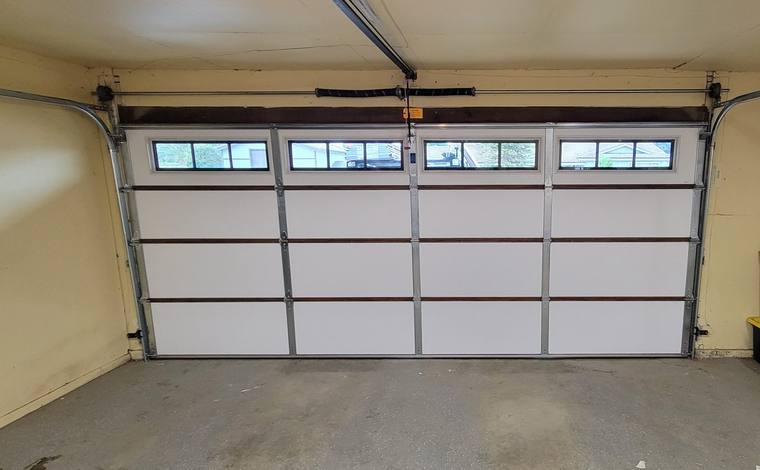
A garage door in Riverside County wears out from ultraviolet, blown grit and daily heat cycling, not from ice. Five of the six zones here do not freeze. So the maintenance year runs on wind and heat — before the first heat wave inland, after the spring wind season in the San Gorgonio Pass, either side of the monsoon in the Coachella Valley, and before December in the mountains. What you can safely do yourself takes about fifteen minutes, needs no tools beyond a ladder, a rag and a 2x4, and includes two safety tests the door manufacturers’ association recommends running monthly. Nothing in it goes near a spring or a cable, because those hold stored energy and are not homeowner work. Looking at a door is free here, and we do not quote repairs over the phone.
Call (951) 232-9778 Monday–Saturday, 8am–6pm · Closed Sunday
What this guide covers
There is a fifteen-minute routine everybody does, a short list of things that mean stop using the door today, and then a calendar that branches six ways. Read the routine, then read your own zone.
Why the usual schedule is wrong here
Brittle springs in January, ice on the bottom seal, freeze-thaw in the track. It is a coherent maintenance model and it is somebody else’s.
The entire national maintenance corpus is built around freezing. That is not a criticism of it — it is written for where most of the population lives. But in Riverside County it produces a calendar that puts the work in the wrong months and points it at the wrong parts. What actually shortens a door’s life here is ultraviolet, blown grit, and being heat-cycled every single day of the year.
This is not our opinion about the local climate; the county has written it down. Riverside County Ordinance 457.107 records, as formal findings of local condition, that “the average wind conditions in Riverside County can vary substantially from region to region with high wind gusts exceeding 50 miles per hour in the desert area”, that the county “experiences annual hot and dry Santa Ana winds”, and that these wind conditions “contribute to blown sand and soil, which can cause erosion of and damage to building materials”. The same findings note that temperatures here “can range from 20 degrees Fahrenheit with snow in Idyllwild to well over 100 degrees” in the desert area.
Read that as a maintenance specification and it tells you three things. Grit is a mechanical problem, not a cleanliness one. Wind is a structural event, not a nuisance. And a single county-wide schedule cannot be right, because the county’s own ordinance describes a ninety-degree spread of conditions inside its boundaries.
So the calendar in this guide is keyed to events rather than to quarters. The first sustained triple-digit stretch inland. The spring wind season in the pass. The monsoon in the Coachella Valley. The first freeze at five thousand feet. Those are the moments that damage doors here, and they do not fall in the same month as each other or in the same month every year.
On the cadence itself, we will be plain rather than salesy. The door manufacturers’ association recommends testing the reversing mechanism and the photo-eye sensors monthly, and having a trained technician look at the door annually. A door used as the family’s main entrance to the house is working several times harder than that assumes. We do not sell a maintenance subscription for homes, and the short answer to how often is already on our answers page rather than restated here.
Next step
The fifteen-minute check below catches most problems. If you’d rather hand it over, or something already looks wrong, start here.
Three quick questions narrow it down before you talk to anyone.
(951) 232-9778Mon–Sat · 8am–6pmDo this one first
The door manufacturers’ association reckons a homeowner inspection can be done in about fifteen minutes. This is that inspection, with the two safety tests they recommend running monthly, and with the preconditions that most published versions leave out.
A stepladder you are comfortable on · A clean rag · A 2x4 laid flat
Time About fifteen minutes, twice a year — plus the two safety tests monthly
Never adjust the force or the travel limits to get a failing reversal test to pass. The test is failing because the door needs attention, and turning the force up removes the protection rather than restoring it. And never raise, move or bypass a photo eye to stop nuisance reversals — the low mounting height is the whole point of the device, and in California the fail-safe behavior of that sensor is a statutory requirement rather than a manufacturer preference. If either test fails, stop using the opener and get the safety system looked at.
Everything above is genuinely homeowner work. The line is drawn at the springs and the cables, and it is drawn there for a reason set out further down.
The escalation list
Every maintenance article says “call a professional for springs” and then gives you no way to know when you have crossed that line. This is the line. Any one of these six means stop operating the door, not book it in for next month.
A torsion spring is a continuous coil. A clear gap of an inch or two in it means it has failed, and the door has just become far heavier than the opener was ever designed to lift. Running the opener now strips the drive gear and frequently pulls the door out of its track, which turns a spring job into a spring, cable, track and panel job. Stop using it and leave it closed.
The lift cables carry the door; the springs only balance it. A cable that has broken strands, hangs slack on one side, or has jumped off its grooved drum means the load path has changed and the door is being held by less than it should be. Look at both cables, not just the obvious one, and then leave it alone — the bottom bracket where the cable terminates is under live tension even with the door shut.
A correctly balanced door lifted by hand to about waist height stays roughly where you put it. One that slides down, or shoots up, is out of balance, which means the springs are no longer matched to the weight of the door. Nobody notices while the opener works, because the motor is quietly taking the difference — and the motor is rated for a fraction of the door’s weight. It is also the state in which a power outage leaves you with a door nobody can lift.
Look along the face of the door from one side while somebody runs it halfway. If the bottom section is pulling away from the strut behind it, or the middle of the door is visibly bowing, the panel is no longer acting as one piece. In the pass this is usually wind pressure; anywhere else it is usually a strut fixing that has worked loose. Either way the rollers are being pushed toward the edge of the track, and a roller that has once been off the track rarely runs the same again.
If nudging the bracket makes the indicator light settle, and letting go makes it flicker again, the mounting has failed rather than the sensor. People live with this for months by holding the wall button to override the safety circuit, which is the deliberate manual override and is not a way to run a door. The override exists so you can close a door in an emergency, not so you can ignore a broken entrapment protection system.
A door that comes down normally and then drops the last hand’s width with a bang is telling you the counterbalance has stopped supporting it at the bottom of the travel. That is where a door is heaviest and where anything underneath it is most likely to be a foot. It is also how bottom sections and astragals get destroyed. This one is easy to normalize because the door still works, which is exactly why it is on this list.
None of this is a sales pitch: an emergency call is priced in front of you before anything is touched, and looking at it is free. What a broken spring or cable costs is a conversation we have after somebody has seen the door.
Found one of those on your door?
Leave it closed and keep people clear of it. Call and we’ll talk you through keeping it safe until we get there.
What, and how often
The baseline is the same everywhere. What changes by zone is how often, and which month it lands in.
| Task | Everyone | Where the zone changes it |
|---|---|---|
| Photo-eye and contact reversal testThe two safety tests, with a 2x4 laid flat. | MonthlyThis is the manufacturers’ association recommendation and it is the one item on this table not to stretch. | Same everywhereIn the desert, expect dust and cobwebs on the lenses to be the usual cause of a nuisance reversal. |
| Watch and listen to a full cycleFrom outside, then from inside. | Twice a yearPair it with the two dates your zone row below gives you. | Pass: after every wind eventCoachella Valley: before and after the monsoon. |
| Look over springs, cables, rollers, hinges and labelsLooking only. Nothing touched. | Twice a yearAnd any time the door starts sounding or moving differently. | Palo Verde Valley: quarterlyCorrosion is the failure mode there and it is not visible early from a distance. |
| Wipe the tracks dryDry rag, and leave them dry. | Twice a yearBefore you lubricate anything, never after. | Desert and pass: quarterlyBlown sand is the reason, and it is the task most worth doing more often out there. |
| Lubricate the moving partsGarage door lubricant, not a general penetrating spray. | Twice a yearManufacturer guidance runs from about three months in heavy use to six in average use. | Desert and pass: the short endGrit, not heat, is what moves you there. |
| Hardware re-torqueHinge, bracket and track fasteners checked for anything backed out. | AnnuallyUsually part of the technician visit rather than a homeowner job. | Pass: after the wind seasonSustained pressure backs vertical track lags out of the jamb slowly. |
| Seal and perimeter checkBottom astragal and both side seals, for hardening, shrinkage and daylight. | Twice a yearManufacturer guidance commonly puts bottom seals on a two-to-three-year replacement. | Desert: the short end of thatMountain and foothill: also a wildland-urban interface item, not just a draft. |
| Balance check by handDoor closed, released, lifted — only if nothing is broken. | Twice a yearAnd before you rely on being able to lift it in a power outage. | Hemet valley: treat as the priority itemOlder stock, and the people who have to lift it in a cut may not be able to. |
| Opener backup battery testUnplug, cycle on the remote, plug back in. | AnnuallyIt is a consumable rated in the low single-digit years, not a fitting. | Seasonal property: before you leave and when you returnDisconnect it if the opener will be unplugged for months. |
| Technician visitBalance, springs, cables, hardware torque, track, safety system. | AnnuallyThe manufacturers’ association recommendation, and the position this table takes. | Book it for your zone’s monthThe six sections below say which month that is and why. |
June is Garage Door Safety Month, established by DASMA and the International Door Association. If you want one fixed date in the year to hang the two safety tests and the annual booking off, that is a reasonable one for most of this county — though the pass and the desert both have better ones, below.
Calendar one
Riverside, Corona, Moreno Valley, Jurupa Valley, Eastvale, Norco, Perris, Temecula, Murrieta, Menifee and Lake Elsinore.
The two weeks either side of the first sustained triple-digit stretch are our busiest of the year, and that is not a coincidence. It is a spring that was marginal all winter giving up when the metal gets hot. So the useful date here is not a quarter, it is that stretch — usually somewhere between late May and early July — and the work belongs in the few weeks before it rather than during it.
What to do in that window is the fifteen-minute routine, with the balance check taken seriously, plus the annual technician booking if you are going to make one. If a door is going to be short of counterbalance by August, it is measurably short of it in May, and it is a great deal easier to get looked at in May.
The second date is October and November, after the Santa Ana events. Those winds drive leaf litter, grit and general debris into the bottom of the vertical tracks, and the first thing you notice is a roller riding up over it rather than through it. This is the visit where wiping the tracks dry actually matters, and where you check the bottom seal for the summer’s worth of ultraviolet it has just taken.
Between those two dates, the thing to do is listen. Stand inside and run one full cycle in October and you will hear a dry roller long before you see anything, because grinding is the first symptom of a bearing packed with dust. That is a scheduled observation, not a diagnosis — what a worn roller actually is is its own page.
The mechanism behind all of this — hardware working loose a fraction on every thermal cycle — is documented across our Western Riverside pages, so it is not repeated here. The maintenance consequence is the part that matters: this is the zone where an annual hardware re-torque does the most good per minute spent, and where west-facing openings should be treated as being a season ahead of the rest of the street.
Calendar two
Hemet, East Hemet, San Jacinto, Valle Vista, Green Acres, Homeland, Nuevo and Winchester.
The heat arrives earlier and harder here than inland, so the pre-heat window moves forward — think May rather than June. And the winter mornings are genuinely cold and damp, which puts a second date in the diary that inland barely needs: the first cold snap, when a spring at the end of its life is most likely to let go.
Those two moments — the first real heat and the first real cold — are when we get the most calls out here, and both are the same underlying thing. Temperature does not wear a spring out. It decides which day the wear becomes a failure.
The specific thing to look for in this zone is what kind of counterbalance you have. A lot of valley stock still runs its original extension springs along the horizontal tracks either side of the door rather than a torsion bar above the opening. If that is what you have, there is a homeowner visual check that genuinely matters: is there a containment cable threaded down the middle of each spring? Without one, a failed extension spring is a projectile. Looking for that cable is on the manufacturers’ association’s own homeowner inspection list, and it is looking only.
The balance check is the priority item here rather than one task among several, and the reason is not mechanical. A great deal of this housing is occupied by people who cannot lift a heavy door. An out-of-balance door is completely invisible while the opener works, and the moment the power fails it has to be lifted by hand. We balance-test by hand on every visit for exactly that reason, and if you do only one thing off this page in this zone, do that one. What a spring replacement involves is separate.
The other valley-specific item is the opener. Units here are routinely older than rolling-code security, and a two-button remote with switches inside the case can be cloned from the street. That is a security finding rather than a maintenance one, but the annual look is when it gets noticed. The pass and Hemet valley run on a booked window from our Riverside shop.
Calendar three
Banning, Beaumont, Calimesa, Cherry Valley, Cabazon and Whitewater.
Here the maintenance year has no fixed dates at all. It has a season — roughly April through June for the sustained winds, and October through December when the Santa Anas run — and inside that season the trigger is each event, not the calendar.
It is worth understanding why wind on a garage door is structural rather than a rattle, because it changes what you inspect. The vertical track is tilted back from the opening and the top rollers sit in the curve at the top, so pressure on the face of the door does not just push it inwards: it imparts an upward force that works to drive the door open along its own tracks. That is DASMA’s explanation and it is the mechanism behind most of what we see out here — rollers walking to the edge of the track, top sections flexing, and lags easing out of the jamb.
So, before an event: close the door and leave it closed. A door left open leaves the walls, ceiling and roof structure exposed in a way a closed door does not, and running a door during a high wind event is not recommended by anybody. If your door has a manual lock installed, it can be used — but only with the operator disconnected, and it has to be unlocked before normal operation resumes. Worth knowing: automating a door usually disables that lock, so on most powered doors it is not available. Finding out which you have is itself an inspection result.
After an event, the order matters. Look first, with the door still closed, from the inside: panels, track, hinges, rollers, cables, and the fasteners into the jamb. Any deformation of any of those makes the door questionable. Only if it all looks intact do you run it — and if anything looks or sounds wrong during that cycle, lower it carefully to closed and stop there.
The recurring finding in this zone is fasteners. Sustained wind does not push once, it pushes thousands of times a day, so vertical track lags back out of the jamb slowly and the door starts to rub on one side. An annual hardware re-torque is the single highest-value job on a pass door, and the right month for it is after the spring wind season rather than before. Banning and the rest of the corridor are covered from Riverside, and a wind-damaged door is a priority call.
There are no wind speeds in this section as design figures. Riverside County publishes design load criteria and directs you to its own hazard tool to establish what applies at an address; that is the right source, and it is not something to restate second-hand.
Calendar four
Palm Springs, Palm Desert, Cathedral City, Rancho Mirage, Indian Wells, La Quinta, Indio, Coachella, Desert Hot Springs, Bermuda Dunes and Thousand Palms.
The two dates out here are June, before the monsoon, and late September, after it. That is the whole calendar, and it is genuinely twice a year rather than once, because the monsoon does something to a door that no amount of annual servicing catches up with.
The single most important thing on this page for the desert is a mechanism that almost nobody explains. In dust-laden air, an oily film on a moving part does not protect it — it holds grit against it. What you end up with is a lapping compound: a paste of lubricant and sand that machines the roller bearings and polishes the track it is running in. The more generously you oil a desert door, the faster you wear it out. This is why the tracks are wiped dry and never lubricated, and why in this zone the cleaning is more valuable than the lubricating.
It also tells you what to look for. A grit-loaded roller does not spin freely when you flick it, it feels stiff and gritty and it will often have a flat worn spot where it has been sliding rather than rolling. If you can hear a dry scraping rather than a rumble, that is the sound of a roller being dragged along a track by an opener.
The photo eyes deserve their own mention here. They sit within about six inches of the floor by design, which is exactly where blown dust settles and where cobwebs get built. In this zone a nuisance reversal is usually a dirty lens rather than a fault, and cleaning them is a rag-and-thirty-seconds job that should be on both visits. Do not solve it by moving the sensor.
One more thing worth having from the manufacturers’ own guidance: doors in climates subject to extreme heat should be kept closed where practical. A door standing open in July is a door whose seals, finish and opener are all taking sun they were not specified for.
Then the case nobody writes about at all: the seasonal property. A door that sits unused from April to October has a completely different failure profile from one cycled daily. Assume the lubricant has dried out, that the rollers have flat-spotted where they have been resting on the same point for six months, that something has nested in or around the tracks and the operator, that the bottom seal has taken a set and no longer meets the slab, and that the backup battery is flat. Look at all of it before you cycle it, and cycle it once by hand before you use the opener. The Coachella Valley is a booked window; sun-damaged sections are their own job.
Calendar five
The mountain communities, where freeze is real and the rest of this guide inverts.
This is the one zone where the national winter advice applies, and the calendar is simple: the work happens before the first freeze, and the springs get checked before December on purpose. A spring near the end of its cycle life fails on the coldest morning rather than a mild one, and up here that is a morning when getting a technician to you is hardest.
The mechanical rule that matters most is short and it is the manufacturers’, not ours: a door that binds is not forced with the opener. If the bottom seal has frozen to the slab, or ice has formed in the lower track, the opener will keep pulling until something gives — usually the seal off the door, sometimes the cable off the drum. Clear the obstruction, or leave the door where it is until it thaws.
Before the freeze, check that the bottom seal still meets the slab along its whole length rather than having hardened and shrunk away at the ends, and check that water is draining away from the opening rather than sitting under the door. Those two things prevent most of what goes wrong here. Pine litter in the vertical track is the other recurring cause of an off-track door at elevation, and it is already covered on the Idyllwild page rather than rewritten here.
Damp does the quiet damage. Fog, snowmelt and shade mean hardware here stays wet far longer than it does in the valley, so the annual look should pay attention to bearing plates, hinge pins and the torsion shaft for surface rust, and to the opener’s logic board for the effects of repeated dew cycles — an intermittent fault that comes and goes with the weather is usually a board rather than a remote.
The seal has a second job in these communities. These are wildland-urban interface areas, and the interface requirements limit the gap between a door and its opening in order to resist ember intrusion. That makes a cooked, shrunken bottom seal a compliance matter and not simply a draft. We are not going to publish a dimension we have not confirmed against the current code text, so ask the county which requirements apply at your address and keep the answer with the door’s paperwork.
Calendar six
Blythe, Ripley, Mesa Verde and Lost Lake.
Every other maintenance guide equates rust with the coast or with road salt, which leaves this valley with no advice at all. The Colorado River and irrigated farmland put humidity into air that is also passing a hundred and ten degrees, and that combination attacks steel in a way neither condition does alone. Out here the inspection is quarterly rather than twice a year, and it is looking for corrosion.
On a spring, corrosion is not cosmetic. DASMA’s technical guidance on springs is explicit: rust reduces the effective area of spring wire, which in turn reduces its overall strength, and it creates corrosion pits from which fatigue cracks can accelerate. In other words a rusted spring fails earlier and less predictably than its cycle rating implies, because the crack starts at the pit rather than at the point the rating assumed. Springs should be kept dry, and in this valley that instruction has consequences.
The cables tell the same story and hide it better. A lift cable is stranded steel, and moisture gets in between the strands, so the core can be going while the outside still looks perfectly serviceable. That is why we look at both cables here rather than only the one that failed, and why the inspection out here is about what you cannot easily see. What a cable failure actually involves is its own page.
Add the bearing plates, the drums and the torsion shaft to the quarterly look, and pay attention to cut edges and fastener penetrations on the door skin, because that is where a finish gives up first. On the seals, expect to be on the short end of every manufacturer interval: this valley gets desert temperatures with river humidity, so the rubber perishes on the desert schedule while the metal corrodes on a coastal one.
There is a useful piece of manufacturer authority for all of this. Care instructions routinely say to double the cleaning frequency in harsh environments — and this qualifies, which means halving the interval is what the manufacturer intended rather than an upsell. Practically, Blythe and the Palo Verde Valley are scheduled deliberately and we arrive loaded, because a part that is not on the truck out here is not a two-hour delay, it is another day.
The boundary, with the reason
Every competitor publishes this list as instructions. The useful column is the third one, because the reason is what lets you judge a case this table does not cover.
| The job | You or a technician | The reason |
|---|---|---|
| Visual inspectionSprings, cables, rollers, hinges, seals, labels. | You | Looking costs nothing and catches most of what matters. The rule is that it stays looking — nothing on the list is touched. |
| The two safety testsPhoto eye, and contact reversal on a 2x4. | You, monthly | They are designed to be run by the owner, and a door that fails one is unsafe now rather than at the next service. |
| Cleaning the photo-eye lenses | You | A rag on a lens is not an adjustment. Moving the bracket is, and that is where it stops being your job. |
| Wiping the tracks dry | You | Cleaning a track is safe and, in the desert and the pass, is the single most valuable thing you can do. Do not grease it afterwards. |
| Lubricating rollers, hinges and bearings | You | Surface work on parts that are not under tension. Follow the door manufacturer’s instruction on nylon rollers and put nothing on a wheel surface. |
| Balance check by handDoor closed, operator released. | You — with preconditions | Safe only after you have looked at both springs and both cables and found nothing wrong. Release with the door fully closed, because a released door can either fall or run open. |
| Replacing the bottom seal | Usually a technician | The astragal sits in a retainer at the bottom of a section that is under cable tension at its brackets, and on some doors the retainer has to be worked at the same time. Judge it by whether anything has to come apart. |
| Hardware re-torqueHinge, bracket and track fasteners. | Technician | The difficulty is knowing which fasteners are structural and which carry live load. The bottom fixture and anything on the spring shaft are not in the same category as a mid-section hinge bolt. |
| Roller replacement | Split — and not the way it looks | The intermediate rollers come out of open hinges. The bottom roller sits in the bottom bracket, which is where the lift cable terminates and which is under live tension even with the door closed. Identical-looking parts, completely different job. |
| Removing more than one hinge at a time | Technician | The hinges are what make the sections act as one door. Take out several and the panel loses its ability to carry itself between rollers. |
| Anything on a torsion spring or its shaft | Technician, always | A wound torsion spring stores enough energy to break bones, and the winding bars sold online are frequently the wrong size for the cone. Getting the wire size wrong on a replacement also destroys the opener within months. |
| Extension spring hardware | Technician | Serviced with the door open, because that is the only state in which extension springs are slack — the opposite of the manual release, which is pulled with the door closed. These two get confused constantly and the mistake is not a small one. |
| Lift cables and bottom brackets | Technician, always | The bottom bracket is where the cable terminates and it is under tension whenever the door is closed. It is the classic injury point on a garage door. |
| Track correction on a loaded door | Technician | Levering a track back into shape with the door hanging in it is how a repair becomes a replacement. The cause of the misalignment also has to be found, or it happens again. |
| Operating a door with a broken spring | Nobody | The springs carry the weight, not the opener. With one broken, the motor is trying to lift a door many times what it is rated for, and that is how drive gears strip and doors come off track. |
| Adjusting force or travel limits | Technician | Turning the force up to make a failing reversal test pass removes the entrapment protection rather than restoring it. If a test fails, the door needs attention, not the setting. |
Anything in the technician column is free for us to come and look at, and we will tell you honestly when something is a five-minute job you could have done yourself. What we actually repair covers the work itself.
Both are on a clock
California has required battery backup on residential garage door openers since July 2019. The odd consequence is that the one component the state actually mandates is the one nobody puts on a maintenance schedule — because it is not a fitting, it is a consumable, and its useful life is measured in a small number of years rather than in the life of the opener.
The annual test takes a minute. Unplug the opener at the wall, cycle the door once on the remote, then plug it back in and check the status indicator. Two things are normal while it is running on battery: the door moves more slowly, and the courtesy light does not come on. If nothing happens at all, the battery is done.
One extra for the desert: if the opener is going to be unplugged for months while a property stands empty, disconnect the battery rather than leaving it connected to a dead opener. The opener page covers the units themselves.
A remote’s coin cell can last up to about five years, and the symptom when it goes is specific and easy to check: press the button and the remote’s own indicator light does not flash. That is the remote, not the opener, and it is worth confirming before anybody quotes you for a receiver.
The more interesting failure is range. DASMA has published technical guidance on this: LED and compact fluorescent lamps generate radio-frequency interference that degrades an opener’s receiver range, and because the bulbs typically sit within inches of the receiver they can interfere even while operating within FCC limits. The classic presentation is a remote that used to work from the end of the driveway and now only works from the curb — immediately after somebody changed a bulb.
Low-interference lamps are sold specifically for this. Other causes worth eliminating before replacing anything are wireless equipment sharing the same frequency band and any new transmitter nearby. This is the single most common reason a homeowner replaces an opener that was working perfectly well.
The arithmetic
Springs are rated in cycles, and a cycle has a formal definition: under ANSI/DASMA 102 it is the door traveling from closed to fully open and back again. Every article you read converts that into a number of years by assuming a household, and the assumption is the part that is wrong for you specifically.
So do the division yourself, because it is the useful version. Two cycles a day is about 730 a year. Four a day is about 1,460. Six a day — which is an ordinary figure for a garage that is the family’s main way into the house — is about 2,190. Take whatever rating your springs were sold with and divide. The answer you get is usually a good deal shorter than the range published in general advice, and it explains why two identical doors on the same street are on completely different schedules.
Then two things that matter more than the rating, and neither is widely published. The first is DASMA’s own caution that spring cycle life may not necessarily coincide with door cycle life — the rating describes the spring under test conditions, not your door in your opening. The second is the one no maintenance article carries at all: painting the door, or adding components to it, can push its weight past the manufacturer’s specification. The springs were sized to a weight. Change the weight and the counterbalance is wrong, which is felt first as a door that no longer stays put at waist height. If you are having a door refinished, that is a spring conversation as well as a decorating one.
The actual cycle-rating tiers, and what a higher-rated spring buys you, are on the spring replacement page. What belongs here is the division and the two cautions.
Questions
Six questions this guide gets asked, and the short versions of its answers.
Call and ask. There’s no charge for a question, and Beau has been doing this since 1996.
(951) 232-9778Mon–Sat 8am–6pmA 2x4 laid flat. DASMA points out that a roll of paper towels may not compress far enough to test the system properly, and a 2x4 on its side gives a height that satisfies both the older federal test object and the taller figure current manuals use.
The door must reverse on contact and return to fully open. If it presses down and stalls, or reverses only partway, stop and have it looked at rather than adjusting the force — turning the force up removes the protection instead of restoring it.
More often than the national guides say, and the reason is grit rather than heat. Manufacturer guidance runs from about three months in heavy use to six in average use, and blown sand is what moves a Coachella Valley door to the short end of that.
The more important half of the answer is what you do first. The tracks get wiped dry and are never lubricated, because an oily film in dust-laden air holds grit against the moving parts and becomes a lapping paste that machines the roller bearings.
Look before you run it. With the door still closed, check from inside: panels, track, hinges, rollers, cables and the fasteners into the jamb. Any deformation of any of those makes the door questionable until somebody has been out.
Only if everything looks intact should you cycle it, and if anything looks or sounds wrong during that cycle, lower it carefully to fully closed and stop. Wind on a garage door imparts an upward force along the tracks rather than simply pushing on the face, which is why the fasteners and the rollers are where the damage shows.
Yes, on a schedule. California has required battery backup on residential openers since July 2019, and the battery is a consumable with a life measured in a small number of years rather than a fitting that lasts as long as the opener.
Test it once a year by unplugging the opener at the wall and cycling the door on the remote. Expect the door to move more slowly and the courtesy light not to work while it is on battery — both are normal. If nothing happens, the battery has gone.
Because LED and compact fluorescent lamps emit radio-frequency noise, and the bulbs sit within inches of the opener’s receiver. DASMA documents this as a routine cause of reduced range, and it can happen even when the lamp is operating within FCC limits.
It is very commonly mistaken for a failing opener. Low-interference lamps are sold specifically for this application, and it is worth swapping the bulb back before anyone quotes you for a receiver or a new unit.
Assume four things have happened: the lubricant has dried out, the rollers have flat-spotted where they have been resting on the same point for months, the bottom seal has taken a set and no longer meets the slab, and the backup battery is flat. Rodents having nested around the tracks or the operator is common enough to be worth a look too.
Inspect all of it before you cycle it, and cycle it once by hand before you use the opener. The first powered cycle of the season is when things break, and it breaks them because nobody looked first.
By zone
Each community page carries its ZIP codes, the real drive from our Riverside shop and what actually breaks doors on those streets.
The year starts with the first sustained triple-digit stretch, and the second date is October and November after the Santa Anas. Covered from Western Riverside and Southwest Riverside.
Earlier and hotter than inland, plus the first cold snap — and the balance check matters more here than anywhere else in the county. Covered from San Gorgonio Pass & Hemet Valley.
No fixed dates. A season, and inside it the trigger is each wind event: look before you run it, then re-torque the fasteners. Covered from San Gorgonio Pass & Hemet Valley and Coachella Valley.
Twice a year rather than once, either side of the monsoon. Tracks wiped dry, never oiled, and the seasonal-property list before the first cycle. Covered from Coachella Valley.
Everything before the first freeze, springs checked before December, and a door that binds is never forced with the opener. Covered from Southwest Riverside and San Gorgonio Pass & Hemet Valley.
Quarterly, and looking for corrosion — on the springs, and inside cables whose outsides still look serviceable. Covered from Palo Verde Valley.
Further reading
The other half of this guide: what to specify for each of the same six zones when the door is past maintaining.
The climate guideSprings, cables, rollers, tracks, panels and openers — what we actually fix, and how a repair goes.
The repair pageWhat moves the number, what the figure covers, and why looking at the door is free.
Our pricing policyThe one visit worth booking
What is actually on the truck for an annual look, so you know what you are booking: the door balance-tested by hand with the operator disconnected, both springs and both cables inspected properly rather than glanced at, the hinge, bracket and track fasteners checked and torqued, the rollers and bearings checked for play and grit, the track alignment checked along its length, both safety systems tested, the moving parts lubricated with the right product for the environment, and the perimeter seals looked at.
The month matters more than the date. Inland, book it before the first heat wave. In the Hemet valley, earlier again, and treat the balance check as the point of the visit. In the pass, after the spring wind season. In the Coachella Valley, either side of the monsoon — and if you only do one, make it the September one. In the mountains, before December. In the Palo Verde Valley, whenever you book it, because the quarterly look is the one doing the work out there.
The honest caveat is the drive. We cover the whole county from one shop on Industrial Ave in Riverside, which means same-day is realistic in the inland valleys and is not a promise we will make for Idyllwild or Blythe — those are a booked window with a firm arrival time, and you will be told which when you call rather than after you have waited. Every community we cover carries the real drive band.
Tell us which community you are in and roughly how often the door gets used. We will give you a two-hour window, and if the fifteen-minute check turned up something on the escalation list, say so when you call and it becomes a priority call instead.
Riverside Classic Garage Doors · 6410 Industrial Ave #3, Riverside, CA 92504 · (951) 232-9778 · Monday–Saturday, 8am–6pm · Closed Sunday