Garage door openers
Gears, boards and motors, and when an older opener isn’t worth repairing.
The opener pageDiagnosing it · Riverside County
Press the button once and pay attention. Silence, a click, a hum, or a door that jerks up and quits: each points somewhere different, and some mean stop right there.

A garage door that won’t open usually has one of five problems: no power to the opener, a remote or lock setting, a failed part inside the opener, a door that’s been disconnected from the opener, or a broken spring that makes the door too heavy to lift. What the opener does when you press the button tells you which. No light and no sound points to power. A click or a hum points inside the opener, unless a spring has failed. A door that lifts a few inches and stops is too heavy for the opener, which very often means a broken spring. If it won’t move by hand either, check for a slide lock first. Don’t keep pressing the button, and don’t pull the emergency release while the door is open.
Call (951) 232-9778 Monday–Saturday, 8am–6pm · Closed Sunday
What this guide covers
Standing in the garage right now? Start with the table, then read the stop rules before you press the button again.
Find your door here
Stand clear, press the wall button once, and watch the rail on the ceiling as well as the door. The chain or belt on the rail moves first, so it shows where the problem is.
| What you see and hear | Most likely cause | Safe for you to check? | What to do |
|---|---|---|---|
| Nothing at all. No light, no sound. | No power: a loose plug, a tripped GFCI outlet, or a tripped breaker. | Yes. | Check the plug, reset any GFCI outlets, then check the breaker. |
| The wall button works. The remote doesn’t. | A dead battery, a lock setting on the wall control, or lost pairing. | Yes. | New battery first, then look for a lock light on the wall control. |
| A click, then nothing. | The motor isn’t starting: heat protection on a hot day, or a failed part inside. | Partly. | Let it cool, or unplug it for a minute. Still clicking means an opener repair. |
| A low hum. Nothing on the rail moves. | A failed part inside, or the motor straining against a door that won’t lift. | Look only. | Let go of the button. Check the springs from the floor. |
| The motor runs normally. The chain or belt doesn’t move. | A stripped drive gear in the opener head. | Look only. | Stop using it. Often a gear repair rather than a new opener. |
| The trolley slides along the rail. The door stays down. | The emergency release has been pulled, or the cord got snagged. | Yes, with the door closed. | Re-latch the trolley. On most units you just run the opener once. |
| It lifts a few inches, then stops or drops back. | The door is too heavy for the opener’s force limit. Very often a broken spring. | Look only. | Stop pressing. Look for a gap in a spring or a slack cable. |
| It opens partway, or not all the way. | Something in the way, a limit set short, a binding roller, or a cable problem. | For obstructions, yes. | Clear its path. If it scrapes or goes up crooked, stop and call. |
| It won’t move, even with the release pulled. | A slide lock that’s engaged, a broken spring or cable, or a door off its track. | The lock, yes. The rest, look only. | Check both sides for a lock. If it’s heavy or crooked, leave it closed. |
The safety eyes near the floor only stop a closing door, so they’re never why a door won’t open. A door that won’t close is a sensor question, and one that closes and goes back up is covered in the reversing guide.
Start here
Pick the closest description. Three questions, no contact details, and you’ll know what to tell us.
Tell Beau what you’re seeing and hearing. There’s no charge for a question.
(951) 232-9778Mon–Sat · 8am–6pmStop rules
Most of the expensive damage happens after the first failure, not during it.
Don’t keep pressing the button. Each press makes the opener pull against a door that won’t lift. That’s how a broken spring becomes a stripped gear, a bent top section, or a door pulled out of its tracks.
Don’t lift a door that feels very heavy. Springs balance a healthy door, so it lifts with moderate effort. Dead weight means the springs aren’t carrying it, and forcing it up puts you under a door with nothing holding it.
Don’t pull the emergency release with the door open. If a spring or cable has failed, the opener may be all that’s holding the door up. Pull it with the door closed, unless you’re sure the springs are intact and someone is holding the door.
Look at the springs, cables and bottom brackets, but don’t touch them. They’re under tension even when the door is still.
Don’t turn up the force setting to make it lift. The force limit is protecting the door, and raising it is never the fix.
Silence, a click or a hum
When nothing moves, the sound from the opener head is your best clue.
Start with power. If the opener’s light stays off and you hear nothing, check that its plug in the ceiling outlet hasn’t worked loose.
Many garage outlets are on a GFCI circuit, the kind with Test and Reset buttons. One tripped GFCI can cut power to other outlets, and it isn’t always in the garage. Check outside and in the bathrooms too.
Then look in the breaker panel for a switch sitting in the middle or off. Flip it fully off, then on. If it trips again, leave it off; that circuit has a fault. If the power is fine and the opener is still silent, the fault is inside it.
Then the door and the opener are fine. Try a fresh battery in the remote. Next, check the wall control. Many have a lock or vacation setting that blocks the handheld remotes while the wall button keeps working. On some models the outside keypad still works in lock mode, so a working keypad doesn’t rule it out. It’s easy to press by accident.
If only your car’s built-in buttons stopped working, the opener compatibility guide covers pairing.
The opener heard you, but the motor didn’t start. On a hot afternoon, that’s usually the motor’s heat protection, and it will run again once it cools.
If it clicks on a cool morning too, a part inside has failed. On older units it’s often the capacitor that helps the motor start; sometimes it’s the motor or the circuit board. None is a homeowner repair, and a capacitor can hold a charge after it’s unplugged. Unplugging the opener for a minute is safe, though, and sometimes clears a board that has locked up.
Watch the rail. It tells you which of three faults it is.
The trolley moves, the door doesn’t. The trolley rides along the rail and hooks to the arm on the door. If it travels on its own, somebody pulled the emergency release, or a ladder snagged the cord. With the door closed, most openers latch back on when you run them once.
The motor runs, but the chain or belt doesn’t move. That’s a stripped drive gear. On many openers it’s plastic and wears out before the motor, so replacing it is often the sensible repair.
A low hum, and nothing moves at all. The motor can’t turn. Either a starting part has failed, or it’s straining against a door it can’t lift. Let go of the button, then check the springs, as shown below, before you blame the opener.
A few inches, partway, or stuck
A door that moves a little and stops has told the opener something is wrong. Find out what before you press again.
Openers have a force limit. If the door takes more effort to lift than it should, the opener stops or reverses instead of pulling harder.
The usual reason is a broken spring. The springs do the lifting; the opener only moves a door they already balance. With a spring gone, the opener manages a few inches, feels the strain, and quits. Less often it’s a slide lock, a jammed roller, or in the mountains a bottom seal frozen to the floor.
Don’t touch anything. Stand inside, well back from the door, and look up at the metal bar across the top of the opening.
Most doors here have one or two torsion springs on that bar: tight coils of steel wire. A good spring is one continuous coil. A broken one has a clear gap where the two halves have spun apart.
No spring above the door? Look along the ceiling tracks for extension springs. A broken one sags or hangs loose on its safety cable.
Check the lift cables up each side of the door too. A cable hanging slack or off its drum is as serious as a broken spring.
Found either one? Stop there. Don’t run the opener, don’t lift the door, and keep people away from it. What comes next, including getting a car out, is in our spring safety guide.
If it stops short at the same spot every time, look for something in the way: a storage rack, a ladder hung from the ceiling, a bike hook, a light fixture.
If nothing is in the way, the opener’s up-travel limit may be set short. Leave that to a technician; limits and force are set together, and a wrong one changes how the door closes too.
A scrape or a shudder at that spot means a roller or the track is binding. A door that goes up crooked, with one side ahead of the other, has a cable or drum problem. Stop immediately.
Leave it where it is, and don’t pull the release. If a spring has broken, the opener may be what’s holding the door up. Keep people and cars out from under it.
If the springs and cables look intact and the door is level, the opener probably stopped on heat or a power blip, and one press after it cools will tell you. If anything looks broken or crooked, call.
Found a gap in the spring, or a slack cable?
Leave the door where it is. Most of these are same-visit repairs. Tell us what you see and we’ll bring the parts.
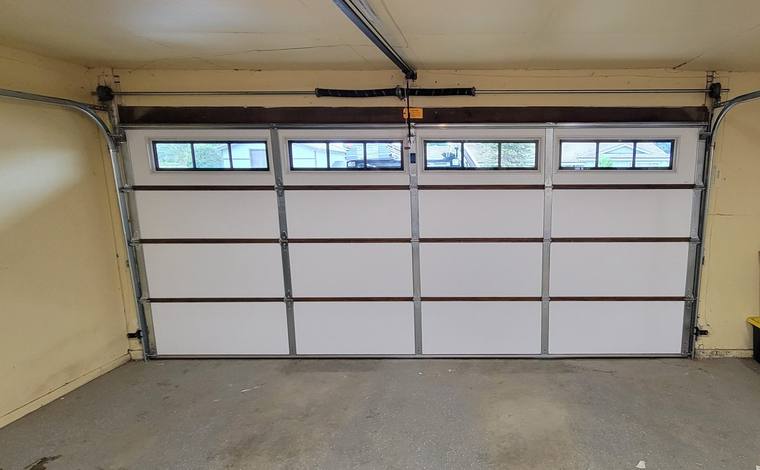
Won’t budge at all
This applies once the release has been pulled with the door closed. Doing that safely has its own guide.
A slide lock or lock bar. Many doors have a bolt inside a lower section that slides into the track, or a lock bar on each side worked by an outside handle. Either one stops the door cold. It’s the most common reason a door won’t budge.
It’s often set by someone who forgot to mention it: a previous owner, a house sitter, family before a trip. Check both sides, and look for a padlock through the track.
A trolley that didn’t let go. Make sure the release actually freed the trolley from the arm on the door.
It feels far heavier than it should, or it won’t stay up when you let go.
A gap in a spring, or a cable hanging slack. The door has lost its counterbalance.
A crooked door, or a roller out of its track. Don’t push it back or run the opener to straighten it.
A bent top section, often from the opener pulling against a locked door.
Before you try anything, read our guide to getting a car out safely. If it can’t be done safely, that’s what an emergency call is for.

If this is what happened
Almost certainly a broken spring. Stop using the opener and call. Don’t lift it on your own.
It’s the remote side, not the door. Battery first, then the lock setting, then re-pairing.
Most likely heat protection. Try again once it cools. If it happens every hot day, have the opener checked.
If someone opened it by hand during the outage, the opener is still disconnected. Our guide to opening it by hand covers the outage itself.
A long outage can also run the backup battery flat. California has required one on openers sold since July 1, 2019.
Usually a released trolley or a board that needs a reset. Run the opener once with the door closed. If it’s dead, unplug it for a minute, then call.
The emergency release has been pulled. With the door closed, re-latch the trolley. Nothing is broken.
A cable or drum problem. Stop now. Don’t run it again. If it’s stuck open, keep everyone out from under it and call.
Riverside County specifics
Three local conditions are worth ruling out before you decide a part has failed.
In the Coachella Valley and the inland valleys, an opener at the top of a hot garage can cut out to protect its motor, a thermal cutout the reversing guide explains. Try the door again in the evening before you decide it’s broken.
Where Southern California Edison supplies power, it can switch lines off ahead of high fire-risk winds. Customers in Banning, Beaumont, Hemet and San Jacinto have all been warned of possible shutoffs. When one is forecast, find your release cord and test the opener’s backup battery.
In the Coachella Valley and around Blythe, fine dust settles on the opener’s rail. Mixed with grease it turns to paste, and a door that stalls partway can simply have a dirty drive. Unplug the opener before you wipe the rail, and don’t pile on more grease.
In the mountain communities there’s a fourth. On a winter morning after rain or snowmelt, the bottom seal can freeze to the slab, and the opener strains as if a spring had broken. Don’t keep pressing; the seal tears first. Free it with a plastic scraper, then try once more.
Questions
Six ways people ask this, answered by what the door is doing.
Call and ask. There’s no charge for a question, and Beau has been doing this since 1996.
(951) 232-9778Mon–Sat 8am–6pmIf the wall button still works, the problem is on the remote side. Try a fresh battery first.
Then check the wall control for a lock or vacation setting. It blocks the handheld remotes while the wall button keeps working. If only a car’s built-in buttons quit, it’s a pairing issue.
The click means the opener tried to start the motor and the motor didn’t start.
On a hot afternoon that’s usually heat protection, and it will run again once it cools. If it clicks on a cool morning too, a part inside has failed, often the starting capacitor. Unplugging it for a minute is safe to try. Beyond that, it’s an opener repair.
Watch the rail while it hums. If the trolley slides along and the door stays put, the emergency release has been pulled. Re-latch it with the door closed.
If nothing on the rail moves, a part inside has failed or the motor is straining against a door that’s too heavy. Let go of the button and look at the springs. A gap in a coil means the spring.
First look for something in its path near the ceiling, like a storage rack or a ladder. If nothing is there, the opener’s up-travel limit may be set short, which a technician should reset.
If it scrapes at the same spot, a roller or the track is binding. If it goes up crooked, stop using it.
Check for a lock first. Many doors have a slide bolt on the inside or a lock bar worked by an outside handle, and either one stops the door cold.
If it’s unlocked and still won’t move, or it feels far heavier than it should, a spring or cable has probably failed. A crooked door may be off its track. Leave it closed and call.
If someone opened it by hand during the outage, the opener is still disconnected. Close the door and run the opener once so the trolley latches back on.
If the opener doesn’t respond at all, check for a tripped GFCI or breaker, then unplug it for a minute. A surge when power returns can damage the circuit board.
Further reading
Gears, boards and motors, and when an older opener isn’t worth repairing.
The opener pageThe most common reason a door won’t lift, and how a new spring is matched to it.
The spring pageFor a door stuck open, a car trapped inside, or a door out of its tracks.
Emergency repairOn the visit
We start the way this page does: press the button, watch the rail, listen to the head. Then we check the door with the opener disconnected, which is the only way to separate a door problem from an opener problem.
If it’s a spring, you’ll see the break before any work starts, and the price is agreed before we pick up a tool. If it’s the opener, we’ll tell you whether it’s worth repairing, and why. Both safety tests are done before we leave, including the contact-reversal test with a 2x4 laid flat.
We work across all of Riverside County from our shop on Industrial Avenue in Riverside, and looking at a door costs nothing.
Tell us what happened when you pressed the button; it tells us what to bring. Looking is free, and the price is agreed before any work starts.
Riverside Classic Garage Doors · 6410 Industrial Ave #3, Riverside, CA 92504 · (951) 232-9778 · Monday–Saturday, 8am–6pm · Closed Sunday