Garage door panel replacement
Whether one damaged section can be replaced rather than the whole door, and what decides it.
The panel pageCalifornia · Insurance and damage
Every page answering this question is written by somebody who sells insurance. This one is written by somebody who repairs the door, which produces a different and more useful answer.
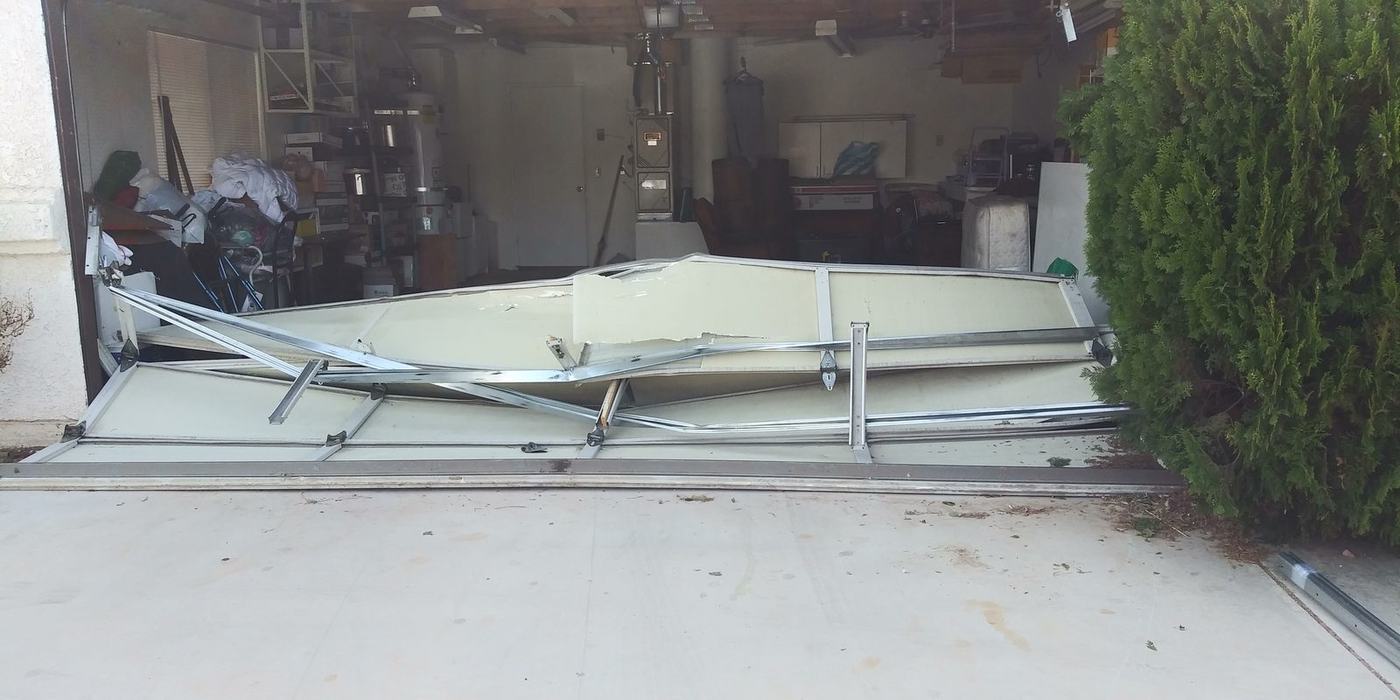
Homeowners insurance generally covers garage door damage caused by a sudden, accidental event, and generally does not cover wear, age or mechanical breakdown. A car reversing into the door, a storm, a falling branch, a break-in or a fire is an event. A spring reaching the end of its cycle life, rollers wearing out, a finish failing in the sun or an opener dying of old age is not an event — it is the thing the part was always going to do. That single distinction answers most of this question before any policy is opened. Two things follow from it. A broken spring is almost never a claim, however sudden it felt. And where a vehicle caused the damage, the claim may sit with the motor policy rather than the home one, which is a question worth asking before anybody files anything. We are a garage door company and not insurance advisers: read your own policy and ask your agent, because coverage differs by policy rather than by the kind of damage alone.
Call (951) 232-9778 Monday–Saturday, 8am–6pm · Closed Sunday
What this guide covers
If you only want to know whether your particular damage is likely to be covered, go to the table. The rest is what an adjuster is actually looking for, and when claiming is the wrong move.
Before you open the policy
Insurers separate things that happened from things that wore out. Almost everything else follows from that.
A homeowners policy is written to respond to sudden and accidental events. Something occurred, on a particular day, that would not have occurred in the normal course of the door existing. A vehicle hit it. A storm drove something into it. Somebody forced it. A fire reached it. Those are events, and they are broadly what the policy is for.
Wear, tear, deterioration and mechanical breakdown are the opposite, and most policies exclude them explicitly. A torsion spring is rated in cycles and will eventually reach that rating. Rollers wear. A finish in full desert sun chalks. An opener has a service life. None of that is an accident; it is a component doing what components do, and an insurer's position is generally that maintaining your own property is your job.
This is why the question “is my broken spring covered?” nearly always has the same answer, and why the answer surprises people. The failure felt sudden — there was a bang like a gunshot and the door stopped working — but the cause was gradual. Suddenness of the symptom is not what a policy is testing for. It is testing for a sudden external cause.
The useful way to frame your own situation, before you call anybody: can you name the event, the day and roughly the time? If yes, you are probably in the territory a policy responds to. If the honest answer is “it just went”, you are probably not, and the more valuable conversation is about the repair rather than the claim.
Everything on this page is the general pattern, not a reading of your policy. Policies differ, endorsements change things, and the only people who can tell you what yours covers are your insurer and your agent. We are the people who can tell you what actually broke and why.
Next step
What failed, and why, decides the claim. We’ll look for nothing and write it down in plain terms.
Three quick questions narrow it down before you talk to anyone.
(951) 232-9778Mon–Sat · 8am–6pmThe situations we actually get called to
The causes we are called out to most, and the general pattern for each. “Generally” is doing real work in every row — your policy decides, not this table.
| What happened | Generally covered? | Whose policy, and what to know |
|---|---|---|
| A vehicle reversed into the doorThe single most common damage call we take. | Usually yes — it is an event | Often the motor policy rather than the home one, and sometimes either. Ask both before filing. If it was somebody else’s vehicle, their liability cover is the first place to look. |
| Storm or wind damagePanels bowed, door pushed off track, debris impact. | Usually yes | Homeowners. In the San Gorgonio Pass this is the common claim. Photograph the whole opening — wind damage often shows in the track and fasteners rather than the panel. |
| Fire, or fire-service damage | Usually yes | Homeowners. Damage caused by the fire service getting in is generally treated as part of the same loss rather than separately. |
| Break-in or vandalismForced door, damaged track or bottom section. | Usually yes | Homeowners. Get the police report number — independent corroboration of the event is what these claims turn on. |
| A tree or branch came down on it | Usually yes | Homeowners, generally regardless of whose tree it was, though your insurer may pursue the other party afterwards. That is their business rather than yours. |
| A spring brokeThe bang, and the door will not lift. | Almost never | Nobody’s. Springs are cycle-rated wear items, and wear is excluded by most policies. Sudden symptom, gradual cause. |
| The opener died | Almost never | Mechanical breakdown, generally excluded. A home warranty is a different product from insurance and may respond where a policy will not. |
| Rust, rot or a failed finish | No | Deterioration, and explicitly excluded by most policies. This is a maintenance and specification question instead. |
| The door came off its track on its own | Usually not | Normally traceable to a worn roller, a failed cable or hardware that worked loose — all wear. Where an external event pushed it off, that is a different conversation. |
| Water or flood damage to the bottom section | It depends, and read carefully | Flood is usually a separate policy from homeowners. Sudden internal water is often treated differently from rising water. This is the row where asking your agent matters most. |
Two rows deserve emphasis. A broken spring is the most common thing we are asked about and the least likely to be covered. And a vehicle impact is the most common thing that IS covered, and the one people most often file under the wrong policy.
Riverside County specifics
Generic insurance advice does not know where you live. These are the three we are called to here, and each has a wrinkle worth knowing.
The pass is one of the windiest corridors in the country and wind damage claims are routine in Banning, Beaumont, Calimesa, Cherry Valley, Cabazon and Whitewater.
The wrinkle: wind damage frequently shows up in the track, the rollers and the jamb fasteners rather than in a visibly dented panel. A door that still closes can be structurally compromised, and an assessment that only photographs the face of the door understates the loss.
If a door has been through a wind event, it is also worth asking whether the replacement should be a rated assembly rather than a like-for-like of something that was under-specified to begin with.
The most common damage call we take county-wide, and the one where people most often file under the wrong policy. A vehicle striking a structure can engage the motor policy, the homeowners policy, or both, depending on the policies and who was driving.
The wrinkle: ask both insurers before you file anything. Filing on the wrong policy is difficult to unwind and can leave a claim on a record for no benefit.
Damage is often confined to one or two sections, and whether a section can be replaced rather than the whole door depends on whether the profile is still made and whether the color will still match.
Idyllwild, Anza, Aguanga, La Cresta, Cherry Valley and the Temecula and Murrieta foothills are wildland-urban interface communities, and fire is a live risk rather than a theoretical one.
The wrinkle: a rebuild in an interface area may have to meet current interface requirements even where the original door did not, because the work is new construction rather than a repair.
That can change the scope of what is being replaced. Establish it with the county and your adjuster early, rather than after a door has been ordered.
The question we get most
This is the single most common insurance question we are asked, and the answer disappoints people, so it is worth explaining properly rather than just asserting.
A torsion spring is rated in cycles — one cycle being the door going up and coming back down. The rating is a fatigue life: the steel is being wound and unwound within its elastic range, and every cycle uses a little of it. When it reaches the end of that life it fails, and it fails abruptly because that is how fatigue fracture works. The bang is dramatic. The process behind it took years.
An insurer looks at that and sees a component reaching the end of its service life, which is the definition of wear. Most policies exclude wear, deterioration and mechanical breakdown explicitly, and a spring failure sits squarely inside that exclusion however sudden it sounded from the kitchen.
There is a narrow exception worth knowing: where a spring failed because of a covered event rather than because of its age. A vehicle impact that bent the shaft, or a fire that annealed the steel, is a different causal story. That is unusual, and it needs the event documented, but it is not impossible.
The practical consequence is that the useful conversation about a broken spring is almost always about the repair rather than the claim. What a spring replacement actually involves is on its own page, and the honest position on cost is that we will not quote it before somebody has seen the door.
At the moment it happens
Claims are weakened far more often by missing evidence than by unfair adjusters. None of this requires touching the door.
A phone camera
Time About half an hour
Having the door repaired before it is documented and assessed. Once it is fixed, the evidence is gone and the adjuster is being asked to take your word for the extent of a loss they cannot see. If the door is unsafe or the opening cannot be left open, photograph everything first and say clearly what you had to do and why.
Want the damage documented properly?
We’ll assess it for free and write down what failed and why, the way an adjuster needs to see it.
The part a contractor should tell you
A contractor who steers every customer toward a claim is working for himself. Sometimes the claim is not worth making.
Every policy carries a deductible, and a claim only returns the amount above it. Where the damage is modest — one section, some hardware — the settlement after the deductible can be small enough that the claim is not worth its own paperwork.
We are not going to publish figures, because we publish none and because your deductible is yours. But it is the first arithmetic to do, and it is done with the written assessment in one hand and your policy in the other.
The second consideration is claim history. A claim is a record, and records can affect renewal terms. Whether that trade is worth making on a modest loss is a judgment for you and your agent rather than for us.
Occasionally somebody asks whether we could describe a worn-out component as storm damage. The answer is no, and it will stay no.
That is partly because it is fraud and partly for a more practical reason: an adjuster who handles garage doors regularly can tell the difference between a fatigue fracture and an impact, and a claim built on a description that does not match the physical evidence fails in a way that is worse than not claiming.
What we will do is tell you honestly what caused the damage. Where that is a covered cause, the assessment says so plainly and in detail, because an accurate assessment is the most useful thing we can give you.
We can come out at no charge, establish what is damaged and what caused it, put that in writing with photographs, separate what is repairable from what needs replacing, and talk to your adjuster about the technical detail if that helps.
We cannot tell you whether your policy covers it, negotiate on your behalf, or advise you on whether to claim. Those belong to your insurer, your agent, and in a serious loss a public adjuster or an attorney. If the door is unsafe or the opening cannot be left, that is the first call regardless of where the claim lands.
Questions
The six we are asked most, answered by a garage door company rather than an insurer.
Call and ask. There’s no charge for a question, and Beau has been doing this since 1996.
(951) 232-9778Mon–Sat 8am–6pmAlmost never. A torsion spring is a cycle-rated wear item, and wear, deterioration and mechanical breakdown are excluded by most policies. The failure feels sudden because fatigue fracture is abrupt, but the cause was gradual and that is what a policy tests for.
The narrow exception is a spring that failed because of a covered event — a vehicle impact that bent the shaft, for instance — rather than because of its age. That needs the event documented, and it is unusual.
Possibly either, and sometimes both, so ask both before you file anything. A vehicle striking a structure can engage the motor policy, the homeowners policy or a combination, depending on the policies and who was driving.
Filing on the wrong one is difficult to unwind and can put a claim on a record for no benefit. If it was somebody else’s vehicle, their liability cover is the first place to look rather than yours.
Storm and wind damage is generally a covered peril on a homeowners policy, and in the San Gorgonio Pass it is a routine claim.
The thing worth knowing locally is that wind damage often shows in the track, the rollers and the fasteners into the jamb rather than in a visibly dented panel. A door that still closes can be compromised, so the assessment needs to cover the whole assembly rather than just the face.
Not if you can avoid it. Once the door is repaired the evidence is gone and the adjuster is being asked to accept a loss they cannot inspect, which is the most common way a legitimate claim gets weakened.
If the door is unsafe, or the opening cannot be left open overnight, do what you have to — but photograph everything thoroughly first and be clear afterwards about what you did and why.
A home warranty is a different product from homeowners insurance, and the two answer different questions. Insurance responds to sudden accidental events; a warranty is a service contract covering breakdown of covered systems.
So the opener that insurance excludes as mechanical breakdown is exactly the kind of thing a warranty may respond to. Read the contract for what it covers and what it excludes, because they vary a great deal.
We can give you the technical half of it: a written assessment of what is damaged and what caused it, photographs, and a clear separation of repairable from replaceable. We are happy to talk to an adjuster about the mechanics, and we do it fairly often.
What we cannot do is tell you whether your policy covers something, negotiate a settlement, or advise you on whether to claim. Those belong to your insurer and your agent, and to a public adjuster or an attorney on a serious loss.
Further reading
Whether one damaged section can be replaced rather than the whole door, and what decides it.
The panel pageIf the door is unsafe, stuck open, or the car is trapped, that is the first call whatever happens with the claim.
Emergency repairIf the door is being replaced anyway, what to specify so the next one survives what took this one.
The specification guideThe practical offer
Coming out to look at a damaged door is free, and it is free whether the outcome is a claim, a repair you pay for yourself, or advice that the damage is cosmetic and can wait. That is the same policy we apply to everything else — looking is free, and we do not quote from a description.
What you get is a written assessment: what is damaged, what caused it in plain mechanical terms, what can be repaired, what has to be replaced, and photographs of all of it. That document is useful to an adjuster because it separates cause from extent, which is the distinction their decision turns on.
And if the honest answer is that this is a wear failure rather than an event, you will be told that too. It is not the answer anybody wants, but it is better heard from us on the driveway than from an adjuster three weeks later. We cover the whole of Riverside County from one shop in Riverside.
Tell us what happened and roughly when. If the door is unsafe or the opening cannot be left, say so when you call and it becomes a priority call. The assessment is free either way, and you keep it whether or not you claim.
Riverside Classic Garage Doors · 6410 Industrial Ave #3, Riverside, CA 92504 · (951) 232-9778 · Monday–Saturday, 8am–6pm · Closed Sunday