Repair · Riverside County
Garage door repair in Riverside County
Springs, cables, drums, rollers, hinges, tracks and panels. Most repairs finish in one visit because the parts are already on the truck when we arrive.
Diagnosis
What the door is doing, and what it usually means
Described the way a homeowner would describe it, not the way a parts catalogue would.
| What you are seeing | Usual cause | What we do |
|---|---|---|
| A bang like a gunshot, then the door will not lift | Torsion spring failure | Replace the spring set. |
| Motor runs, door does not move | Broken spring, or a stripped opener drive gear | Spring set or gear kit. |
| One side has dropped, door sits crooked | Cable slipped off the drum, or snapped | Re-cable and re-balance. |
| Closes most of the way, then reverses | Safety sensors misaligned or dirty | Realign and test. |
| Grinding, squealing, shaking the house | Worn steel rollers, dry hinges, failing bearings | Nylon roller set and bearings. |
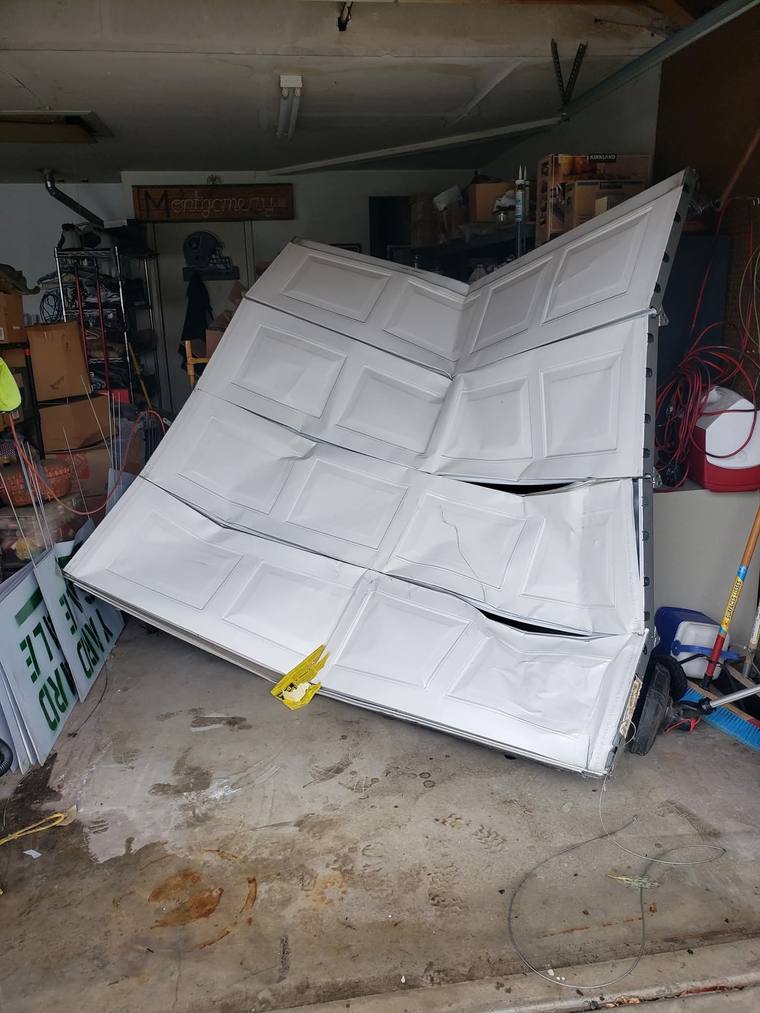
| Door hanging at an angle, rollers out of the track | Impact, or a cable failure left unattended | Stop using it. Emergency call. |
| Bottom section dented or split | Vehicle contact or age | Single panel swap where stock allows. |
Why this matters
A broken spring is not a door problem yet. It becomes one fast.
The springs, not the opener, carry the weight of the door. A double garage door runs 150 to 250 lb, and a correctly wound spring balances almost all of it — which is why a healthy door lifts with one hand.
When a spring lets go, that entire weight transfers to a motor rated to pull about 30 lb. Run it a few more times and you turn a spring job into a spring, cable, track and panel job. The door in this photograph was three panels of damage past where it needed to be.
If you heard the bang, stop using the opener. That single decision is usually the difference between one invoice and three.
Repairs we carry out
Every job, answered plainly
Torsion spring replacement
Torsion springs sit on a bar above the door and are rated in cycles — one open and one close is a cycle. A standard 10,000-cycle spring lasts roughly seven years on average household use. We replace them in pairs, because when one goes the other is the same age and days behind it.
We fit higher-cycle springs where the door is used heavily, which is common on a garage that doubles as the main entrance to the house. The price difference is small and the interval between visits roughly doubles.
Extension spring replacement
Extension springs run along the horizontal tracks either side of the door and stretch as it closes. They are common on older Riverside homes. They must be fitted with safety containment cables so that if one snaps it cannot whip across the garage.
If your extension springs have no containment cable threaded through them, that is worth fixing regardless of whether they have failed yet.
Cable and drum replacement
Lift cables wind onto drums at each end of the torsion bar and carry the door up. A frayed or snapped cable drops one side, jams the door in the opening and puts the whole assembly out of square. It is a same-visit repair, but it should not be delayed.
Cables usually fray from the bottom bracket up, where water sits. Worth a look every time you are in the garage.
Rollers, hinges and bearings
Most builder-grade doors ship with steel rollers that have no bearings. They wear, then grind, then shake the door. Swapping to sealed nylon rollers is the single cheapest thing you can do to quieten a door and take load off the opener.
On a door that is loud but working, this is a scheduled job, not an emergency one.
Track realignment
Vertical and horizontal tracks guide the rollers. A knock from a vehicle, a loose lag bolt, or a cable failure can pull them out of alignment. A door running on a bent track will bind, wear the rollers fast, and eventually come off.
Where a track is kinked rather than merely shifted, replacement is the right call. A straightened track never runs quite the same.
Panel replacement
A single damaged section can often be replaced rather than the whole door, provided the model is still in production and the colour still matches. On doors more than about fifteen years old, a match is unlikely and replacement usually makes better financial sense.
We will tell you honestly which side of that line your door sits on. Sometimes the answer is that a panel swap is throwing money at a door with two years left in it.
Weather and bottom seal
The bottom seal keeps out water, dust and the wildlife that comes with an Inland Empire summer. Perished rubber is a fast, inexpensive fix and is worth doing at the same visit as any other work rather than as a call of its own.
The visit
What a repair call looks like
- You describe it, we bring the partsThe diagnosis tool or a two-minute phone call tells us what to load. That is why most jobs finish first visit.
- We test the door balance before quotingManual release, lift to waist height, see if it holds. That test tells us more than any conversation.
- You approve a written priceItemised — parts, labour, call-out. It does not move once work starts.
- We fix it and re-balance the doorA repair that leaves the door out of balance is not finished. We set the spring tension properly and test the safety reverse before we leave.
Warranty
Parts: [[WARRANTY-PARTS]] · Labour: [[WARRANTY-LABOR]]. Written on the invoice, not just said at the door.
Get it looked at
Call and describe the noise. Or run the diagnosis first and arrive at the conversation already knowing what broke.
Questions
Repair questions,answered straight.
Springs, cables, rollers and openers. If your question is not here, the full answers page covers another thirty.
Bo has been doing this over thirty years. Ring and ask — there is no charge for a question.
(951) 232-9778Mon–Sat · 8am–6pmWhy did my garage door spring break?
Torsion springs are rated in cycles, one cycle being a single open and close. A standard 10,000-cycle spring lasts roughly seven years on average household use. They fail from metal fatigue rather than misuse, which is why failure is sudden rather than gradual.
Cold snaps and heavy use both shorten the interval. A garage used as the main entrance to the house can run three or four cycles a day, which halves the expected life against a household that uses it twice.
Can I still use my garage door with a broken spring?
No. The springs carry the weight of the door, not the opener. With a broken spring the opener is trying to lift 150 to 250 lb on a motor rated for about 30. Running it strips the drive gear and often pulls the door off its track.
If you have already heard the bang, the cheapest thing you can do is stop. A spring job left alone stays a spring job. A spring job that keeps being operated becomes a spring, cable, track and panel job.
How long do garage door springs last?
Between seven and twelve years for most households. Springs are rated in cycles rather than years, so the honest answer depends on how often you open the door. A 10,000-cycle spring on a door used four times a day is spent in under seven years.
Higher-cycle springs cost a little more and roughly double the interval. On a garage that doubles as the main door to the house, they usually pay for themselves.
Should garage door springs be replaced in pairs?
Yes, on a two-spring door. Both springs are the same age and have taken the same number of cycles, so when one fails the other is usually weeks or months behind it. Replacing one means paying the call-out twice.
Can I replace a garage door spring myself?
We would strongly advise against it. A wound torsion spring stores enough energy to break bones, and winding bars slip. It is one of the few household repairs that regularly sends people to hospital.
If you are determined to try, at minimum use proper winding bars rather than screwdrivers, and never stand directly beneath the bar.
What is the difference between torsion and extension springs?
Torsion springs sit on a steel bar above the door opening and twist as the door moves. Extension springs run along the horizontal tracks either side and stretch. Torsion is the modern standard; extension is common on older Riverside homes.
Extension springs must have safety containment cables threaded through them. If yours do not, that is worth fixing whether or not they have failed.
How do I know if my spring is broken?
Look at the spring above the door. A broken torsion spring shows a clear gap of an inch or two in the coil. The door will also feel enormously heavy if you try to lift it by hand after pulling the release, and the opener will strain without moving it.
Why does my garage door reverse when it closes?
Almost always the safety sensors near the floor are misaligned, dirty or blocked. They are two small eyes facing each other across the opening, and if the beam breaks the door reverses. It is the least expensive call on the list.
Never disable the sensors to force the door closed. They are a federal safety requirement and they exist because doors used to close on children.
My opener runs but the door does not move. Why?
Two likely causes. Either a spring has broken and the door is too heavy for the motor, or the plastic drive gear inside the opener has stripped. Check the spring first; if the coil has a visible gap, the opener is not the problem.
Should I repair or replace my garage door opener?
Repair is usually right if the unit is under ten years old and the fault is a gear, sensor or remote. Replacement makes more sense on an older unit, because parts get scarce and you gain quieter operation, battery backup and phone control.
California requires battery backup on openers installed since 2019, so a replacement will have it whether you ask for it or not.