Dock equipment · Riverside County
The door and the dockfail together.
Levellers, seals, bumpers and the hardware around them. Treating them as separate trades usually means paying for two visits to fix one problem.
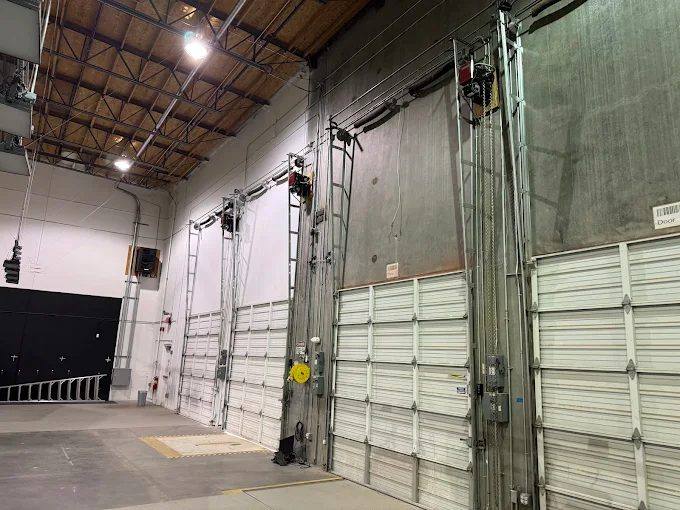
What is on a bay
Four things,and they interact.
A loading bay is a door, a leveller, a seal or shelter, and bumpers. When a trailer backs in hard, the bumpers take it. When they are worn through, the impact goes into the dock face, the seal and eventually the door frame.
That is why we look at all four. A door that keeps going out of alignment on a bay with flattened bumpers is not a door problem, and replacing the door will not fix it.
Levellers are the piece most often left until it fails completely. Mechanical and hydraulic units both have serviceable wear parts, and a leveller that is dropping slowly is telling you something well before it stops.
What we cover
- LevellersMechanical and hydraulic
- Seals and sheltersReplacement and repair
- BumpersLaminated and moulded
- Dock doorThe door itself, obviously
- RestraintsWhere fitted
- InspectionAll four as one visit
Why it is one job
Fixing the doorwithout the bumpers is a return visit.
We have been called back to bays three times for the same door before anyone mentioned the bumpers had been flat for a year.
- Worn bumpersSend trailer impact into the dock face and the door frame. Cheapest part on the bay, most expensive to ignore.
- A failing sealLets weather and dust into the building and accelerates everything else.
- A dropping levellerRarely fails suddenly. It tells you for months first.
How we work a bay
- Look at all fourDoor, leveller, seal and bumpers, in one visit.
- Say what is causing whatOften one worn part is driving three symptoms.
- Price it as one jobRather than four call-outs across a year.
- Put it on a scheduleBays are the clearest case for planned maintenance we see.
Doors and docks are one system. We would rather look at both than fix half of it twice.
Have the whole bay looked atnot just the door.
Book a site visit and Bo will go over the door, leveller, seal and bumpers together, then tell you what is actually causing what.
What comes back
- What failed and whyUsually one worn part driving several symptoms.
- What is urgentAnd what can genuinely wait.
- A schedule if you want oneBays are the clearest case for planned maintenance.
Questions
Dock questions,answered plainly.
Levellers, seals, bumpers, and why we look at all of them together.
Ring and ask. Bo has been doing this in Riverside County for over thirty years and there is no charge for a question.
(951) 232-9778Mon–Sat · 8am–6pmHow fast can you get to a commercial breakdown?
Within working hours and inside Western Riverside County, usually the same day. We ask what the door is stopping when you call, because a dock door blocking despatch is a different priority to a store-room door that can wait until Thursday.
Do you offer scheduled maintenance contracts?
Yes. Most commercial sites are better off on a schedule than waiting for failures, because a planned visit costs a fraction of a breakdown that stops work. We set the interval by cycle count rather than by calendar.
A door opening two hundred times a day wears out roughly ten times faster than a domestic one. Servicing it annually is not enough.
Can you service doors you did not install?
Yes, and most of our commercial work is exactly that. We service and repair whatever is already on site regardless of who fitted it, and we will tell you honestly when a door is past economic repair rather than keep patching it.
Do you work on dock equipment as well as doors?
Yes, levellers, seals, bumpers and the surrounding hardware. A door and a dock fail together often enough that treating them separately usually means two visits for one problem.
Can you work outside our business hours?
We work Monday to Saturday, 8am to 6pm. If a job needs doing outside trading hours to avoid stopping your work, say so when you book and we will schedule it, but we will not pretend we run a night shift.
How long does a commercial door last?
It depends almost entirely on cycles rather than years. A door cycling two hundred times a day will need springs and rollers annually and a full replacement far sooner than a domestic one. We size springs to the actual duty cycle for that reason.